
Need Support?
Please provide your question. We’ll find you with the best support options.

Table of Contents
1. Where Are Bearings Used in a Wheelchair?
2. Challenge 1: Outdoor Dust and Grit—Seal Type Comes First
3. Challenge 2: Moisture and Rust—Material and Grease Go Together
4. Challenge 3: Impact Loads—Don't Overlook Clearance and Fit Tolerance
5. Challenge 4: Hair and Fiber Wrapping—Look at the Seal and Axle Design Together
6. Common Wheelchair Bearing Sizes
7. What Are the Common Failure Modes of Wheelchair Bearings?
8. What to Prepare When Requesting a Quote for Wheelchair Bearings
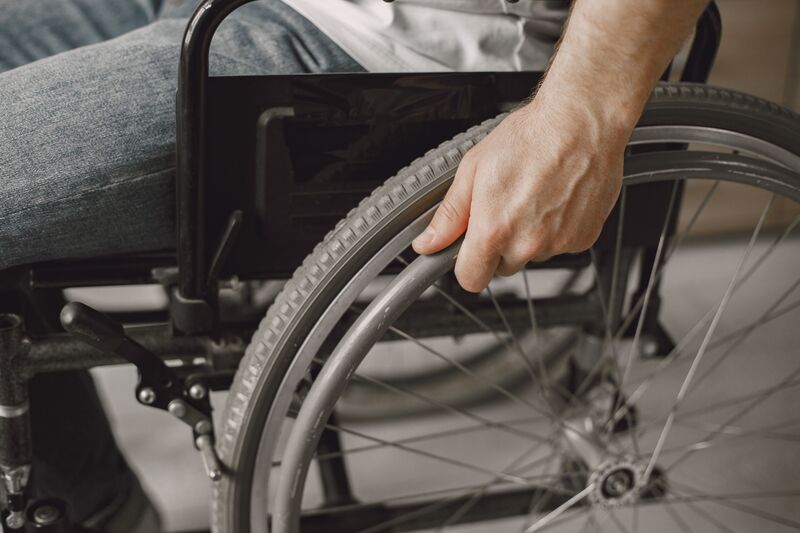
Choosing wheelchair bearings comes down to handling four conditions at once: outdoor dust, moisture-driven corrosion, impact loads from curbs and rough surfaces, and hair or fiber wrapping around the caster axle. The key decisions are seal type, material (chrome steel vs. stainless steel), and internal clearance—assessed against mounting position, environment, and load, not just matching a part number.
A wheelchair looks mechanically simple, but its bearings work in a demanding environment: long hours outdoors, frequent exposure to moisture, repeated impact from curbs and potholes, and hair, thread, and fibers picked up off the floor. Many product developers select a dimensionally correct part number at the drawing stage, only to find noise, rough rotation, or early rust during field testing or after launch. When
ISK Bearings supports equipment makers and brand owners on bearing selection, the point we raise most often is this: wheelchair bearing failures usually aren't the wrong size—they're the result of operating conditions that weren't fully factored in.
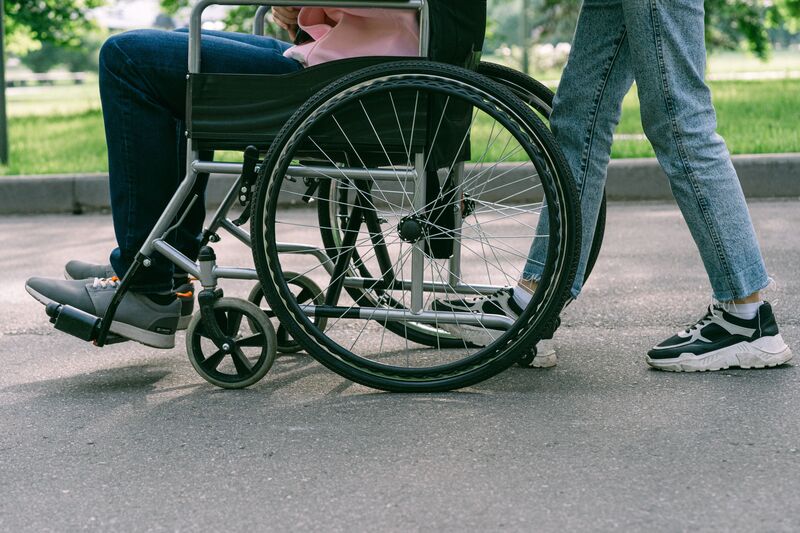
Wheelchair bearings sit in three main load-bearing positions: the hub of the drive wheels (rear), the axle and swivel fork of the front caster wheels, and the motor and drivetrain of powered wheelchairs. Speed, load direction, and environmental exposure differ at each position, so the selection logic can't be one-size-fits-all.
The drive wheels carry the user's weight and propulsion force—mostly radial load, at low-to-moderate speed but in continuous use. The front casters are smaller, run at relatively higher speed, and sit closest to the ground, making them the highest-risk position for rust, noise, and binding from water spray, grit, and wrapped-up fibers. Powered wheelchairs add motor-end and gearbox bearings, which are more sensitive to speed stability and noise. Understanding the condition at each position is the first step in selection.
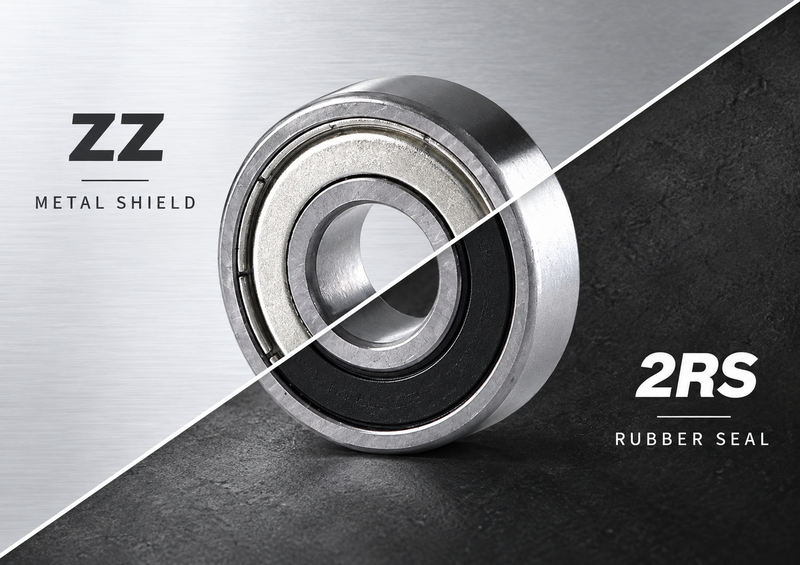
For outdoor dust and grit, seal type matters more than material. Open bearings and metal shields (ZZ / Z) can't hold back fine dust and moisture, so outdoor wheelchairs should favor rubber contact seals (2RS / RS) to reduce wear and binding from contamination.
Wheelchair casters run close to the ground, and the dust, sand, and water they kick up constantly hit the bearing seals. A metal shield (e.g., 608ZZ) relies on a non-contact labyrinth gap, so its dust protection is limited. A rubber contact seal (e.g., 608-2RS) presses a lip against the inner ring, giving noticeably better protection against dust and splashing—at the cost of slightly higher rotational resistance.
For wheelchairs, which run at low speed and prioritize weather resistance and service life, sealing is usually more important than minimal friction. This is a trade-off that depends on the actual use environment; if the product is mainly used indoors, the balance may shift.
The seal choice for wheelchair bearings is mainly a trade-off between metal shields (ZZ) and rubber contact seals (2RS). ZZ offers low rotational resistance and suits clean or indoor environments; 2RS offers better dust and water protection—and better resistance to fiber ingress—for outdoor and humid conditions, at the cost of slightly higher resistance.
The table below compares the characteristics of the two seal types for reference.
| Seal Type | Dust/Water Protection | Rotational Resistance | Recommended Environment |
|---|---|---|---|
| ZZ (metal shield) | Moderate | Low | Indoor, clean, low contamination |
| 2RS (rubber contact seal) | Better | Slightly higher | Outdoor, humid, dusty, fiber-prone |
For most wheelchair products used outdoors, a 2RS seal with suitable grease is usually the more robust starting point—but if the product is designed for an exceptionally smooth push feel, the balance between sealing and resistance needs weighing.
To address rust risk in wet environments, you can't just swap the material—you need to review material, seal, and grease together. Standard chrome steel bearings (GCr15 / 52100) perform reliably in dry conditions, but under prolonged moisture or water contact, stainless steel (e.g., AISI 440 series) paired with water-resistant grease and 2RS seals is a more complete anti-corrosion combination.
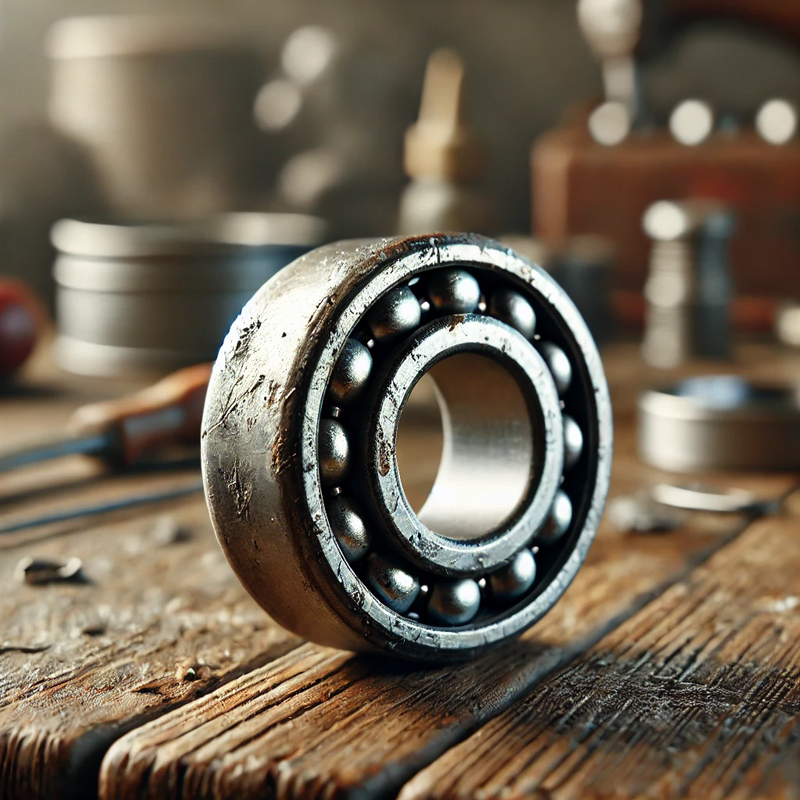
Rust is one of the most common complaints on wheelchair bearings, especially in rainy, coastal, or frequently-washed healthcare settings. The first instinct is often "just switch to stainless," but in practice, if the seal lets moisture in continuously or the grease can't handle water, a material upgrade alone has limited effect.
When ISK helps a customer decide, we confirm three things together: whether the bearing is in prolonged direct water contact, whether cleaning involves water washdown, and whether the environment contains salt or chemical cleaners. Different answers point to different material-and-grease combinations—which is exactly why we suggest describing the real usage environment before finalizing, rather than simply specifying "stainless" and calling it done.
For the repeated impact of curbs and potholes, the focus is on internal clearance and shaft-housing fit tolerance. Impact loads subject the bearing to sudden high stress: too little clearance risks seizing or heat build-up under impact, while too much clearance produces noise and play. Both need to be assessed against actual load and fit.
 Further reading: What is the Meaning of C3 in Bearing? An Essential Guide to Precision in Machinery
A wheelchair almost never travels on a perfectly flat surface—crossing curbs, descending steps, rolling over small holes all create short bursts of high impact load. Under these conditions, the choice of internal clearance and the interference fit at installation directly affect performance after impact. If the drawing tolerances aren't matched properly, you can get the classic case of "the drawing specs are all correct, but it binds or makes noise once assembled"—precisely what engineering teams fear most: correct specs, poor assembly. Diagnosing this requires looking at load, fit, and clearance together, and usually needs a drawing or sample to give a firm recommendation.
For hair, thread, and carpet fibers, the focus is on seal integrity and the clearance design between the axle end and the fork. Wrapping usually happens on the outer axle end between the caster hub and swivel fork; once it builds into a knot, it presses on the seal lip, raises rotational resistance, and drags in moisture and dirt—so it needs assessing against the actual caster structure.
Wheelchairs—especially in home care, hospital, salon, or textile-related settings—roll over floors covered in loose hair, lint, and thread. As the caster turns, these fibers get drawn into the gap between the axle and the fork and gradually wrap around the outer axle end. The wrapping itself is usually not a problem inside the bearing, but once it knots up it presses on the seal from outside: pulling the contact seal lip outward, causing uneven wear, and even drawing fibers into the gap between seal and inner ring, letting moisture and dirt follow. The result is a caster that turns progressively harder and starts making noise—and on teardown the finding is often "the bearing isn't damaged, it was wrapped with hair."
This is a root-cause point we often flag: a binding caster doesn't necessarily mean bearing failure. In selection terms, a rubber contact seal (2RS) generally resists fiber ingress better than a metal shield, and the lip's fit and retention affect how it holds up under wrapping; but whether wrapping is meaningfully reduced depends largely on the caster's own axle clearance and debris-guard design, which goes beyond a single bearing. In practice we suggest looking at seal type and caster structure together, and providing a sample or drawing where needed, to judge whether the fix lies in the seal or in the axle design.
The table below shows common deep groove ball bearing part numbers for wheelchair casters and hubs, with basic dimensions (unit: mm). Actual selection still depends on mounting structure and load.
| Part No. | Bore d | OD D | Width B | Typical Position |
|---|---|---|---|---|
| 608 | 8 | 22 | 7 | Front caster, small swivel wheel |
| 6000 | 10 | 26 | 8 | Caster, light hub |
| 6001 | 12 | 28 | 8 | Hub, swivel fork |
| 6002 | 15 | 32 | 9 | Drive wheel hub |
| 6003 | 17 | 35 | 10 | Drive wheel hub |
| 6203 | 17 | 40 | 12 | Higher-load drive wheel |
As the table shows, wheelchair bearing bores cluster between 8 and 17 mm, but the same bore may call for a different OD series depending on load (for example, 6003 and 6203 both have a 17 mm bore but different load capacities)—a selection detail that is easy to overlook.
Further reading: Deep Groove 6203 Ball Bearings 17mm X 40mm X 12mm
The most common failure modes of wheelchair bearings include: wear from contamination entering after seal failure, corrosion from moisture, raceway indentation and noise from impact loads, rough rotation from grease dry-out or wash-out, and increased seal load and rotational resistance from hair or fiber wrapping around the axle end. These problems often surface only some time after a product ships, and the root cause isn't necessarily the bearing quality itself.
Take the "same problem keeps recurring" concern that quality and maintenance teams care about most. Noise and binding in wheelchair bearings can trace back to the wrong seal type, grease that can't handle the environment, fit tolerance deviation, the cleaning method (high-pressure washdown flushing out the grease), or even external hair and fibers wrapped around the axle end. Replacing with the same part number without reviewing the operating conditions is likely to reproduce the same failure.
When ISK helps diagnose these recurring problems, we first clarify when the failure occurs and under what conditions, then decide whether to adjust the seal, material, clearance, or usage guidance—getting the root cause right is what stops the endless re-ordering of parts.
When requesting a quote for wheelchair bearings, we suggest providing: mounting position (caster / hub / motor end), part number or inner and outer diameters, use environment (indoor / outdoor / water contact / high hair and fiber presence), estimated load or user weight range, annual quantity, and a drawing or sample. The more complete the information, the more precise the selection judgment and quotation.
Many inquiries start with just a part number—"I need 608-2RS," for example. We can quote that, but if we know it's for the caster of an outdoor powered wheelchair, exposed to rain frequently, running on hair- and fiber-strewn floors, at several thousand units a year, we can further assess whether the seal and material need adjusting, rather than simply supplying a standard part.
ISK's value isn't only in supply—it's in helping judge, against the real application, whether a given spec is genuinely suitable. This matters especially for wheelchairs, a product closely tied to user safety and experience, where a small selection difference can be the dividing line between few and many field complaints after launch.
Next Step: Sharpen Your Selection Decision
If you're developing or updating a wheelchair-related product and already have a part number, spec, drawing, or sample—or you're evaluating alternative supply for outdoor, moist, impact, or fiber-wrapping conditions—share your mounting position, use environment, and estimated quantity. ISK will help assess spec suitability and provide selection and quotation guidance.
Share your application requirements for a selection and quote assessment →
608 (8 mm bore, 22 mm OD, 7 mm width) is the most common size for front wheelchair casters. For outdoor use, the 608-2RS rubber-sealed version is recommended for better dust and water protection.
Not necessarily. In dry environments without water washdown, chrome steel with a 2RS seal is often sufficient. Stainless steel with water-resistant grease is worth evaluating for prolonged moisture, water contact, or salt-laden environments.
Not necessarily. Insufficient sealing letting moisture in, or grease that can't handle water, can also cause rust. Review the seal type and grease together rather than just changing the material.
A common cause is hair, thread, or fiber wrapped around the axle end between the wheel and the fork, pressing on the seal and adding resistance. This often relates to the caster's axle clearance design—review the seal type and caster structure together.
It may be an improper match of internal clearance and fit tolerance, or deformation under impact load. This needs assessment against the drawing, load, and fit—providing a drawing or sample helps confirm.
Please provide your question. We’ll find you with the best support options.