


Need Support?
Please provide your question. We’ll find you with the best support options.

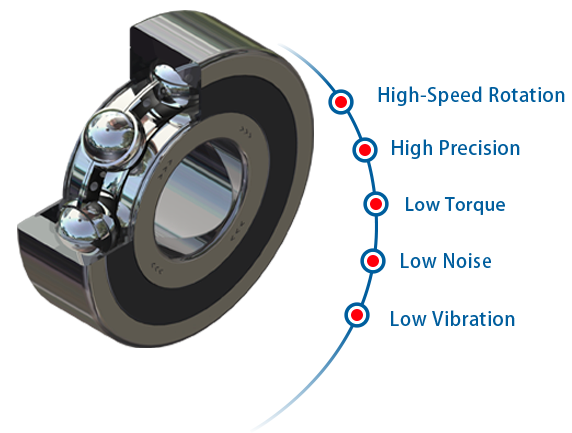
Ball bearings are versatile components known for their ability to reduce friction and minimize shaft yaw during rotation. Their excellent characteristics, such as high-speed rotation suitability, precision, low torque, and minimal noise and vibration, make them a crucial choice in various industries, including automotive, home appliances, and other industrial machinery. With a wide range of uses, types, and standardized sizes, selecting and exchanging these bearings during installation and disassembly is straightforward.
When classifying ball bearings, three main types stand out: deep groove ball bearings, thin-wall ball bearings, and miniature ball bearings. Among them, deep groove ball bearings are the most widely used and are extensively applied across various industries. Thin-wall ball bearings, on the other hand, feature exceptionally slim cross-sections, helping reduce the overall weight of end products. Miniature ball bearings generally refer to metric-series bearings with an outer diameter of less than 9 mm. Choosing a reliable bearing supplier is essential to ensuring high-quality bearings.
 Further Reading: Dive into the Significance of Ball Bearing Size and Dimensions
Please provide your question. We’ll find you with the best support options.