 TOP
TOPNeed Support?
Please provide your question. We’ll find you with the best support options.

Summary
This article is an in-depth technical guide on self-lubricating bearings, intended for engineers and technical procurement professionals who need to perform selection calculations or diagnose wear issues. Topics covered include: the transfer film self-lubrication mechanism of DU bearings, a full specification comparison of DU PTFE vs. DX POM, material selection for special environments (bimetal, bronze wrapped, solid lubricant embedded), common causes of abnormal wear and prevention, and PV value calculation logic with grease selection recommendations.
→ If you are not yet familiar with the basic definition and structure of self-lubricating bearings, we recommend reading first: Self-Lubricating Bearing (Bushing) Technical Guide: Principles, Materials & Application Evaluation
Table of Contents
- DU Bearing Self-Lubrication Mechanism: How Does the Transfer Film Work?
- DU PTFE vs. DX POM: Full Composite Material Specification Comparison
- Material Selection for Special Environments: Bimetal, Bronze Wrapped, Solid Lubricant Embedded
- Common Causes of Abnormal Wear in DU Bearings & Prevention
- Advanced Selection: How to Evaluate Pressure, Speed, and PV Value?
- Slow-Speed or Frequent Start-Stop Equipment: How to Choose the Right Grease?
.jpg)
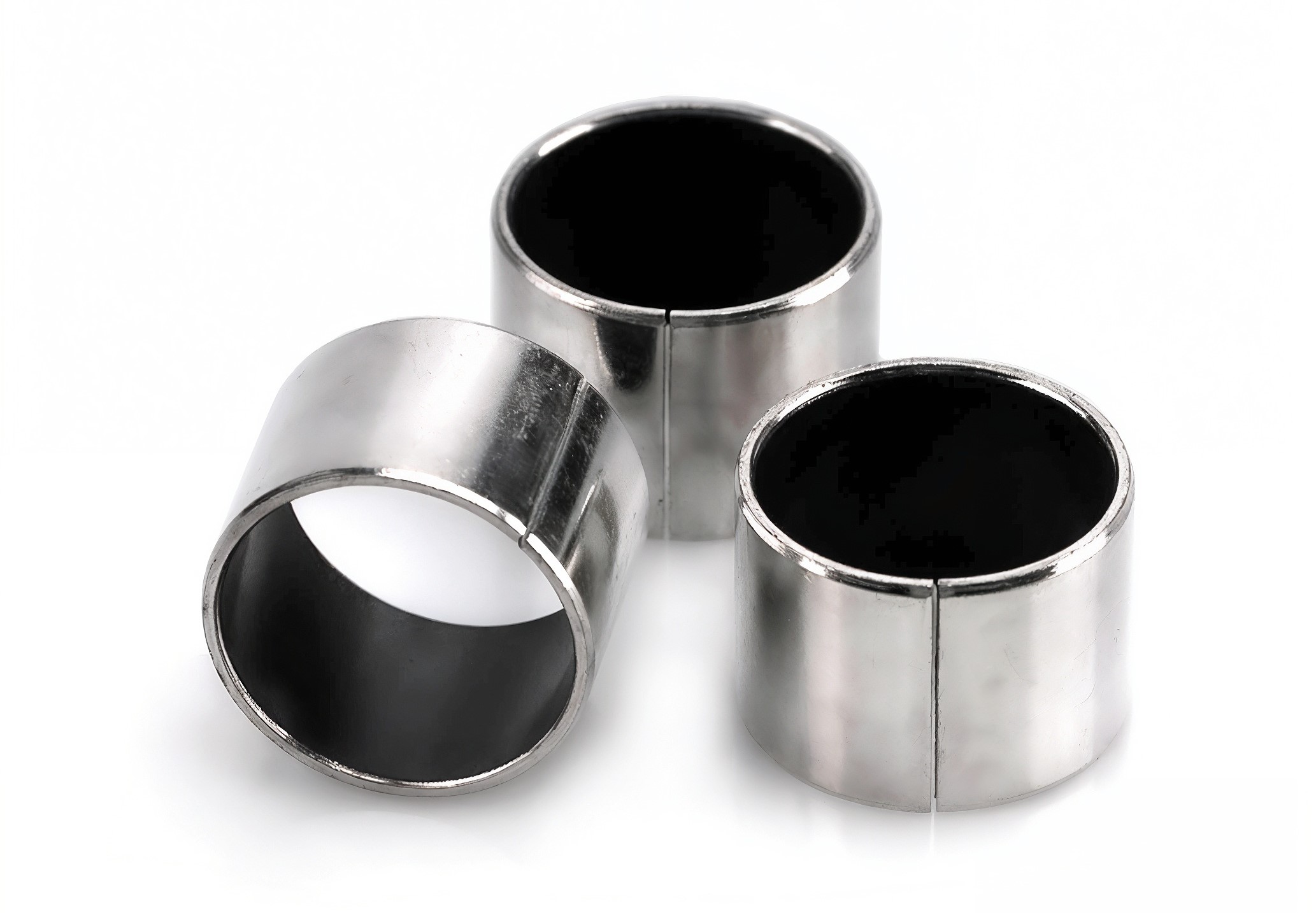
The self-lubrication mechanism of self-lubricating bearings does not take effect immediately — it is gradually established during the initial run-in phase: the solid lubricant in the bearing's PTFE inner layer is progressively transferred and deposited onto the surface of the mating component (the shaft) through repeated friction, forming a stable solid lubricating film (Transfer Film).
Once the transfer film is formed, it effectively eliminates direct metal-to-metal contact between the bearing and the shaft, converting friction from "metal-on-metal" to "PTFE film-on-metal." This dramatically reduces the coefficient of friction and extends the service life of both components.
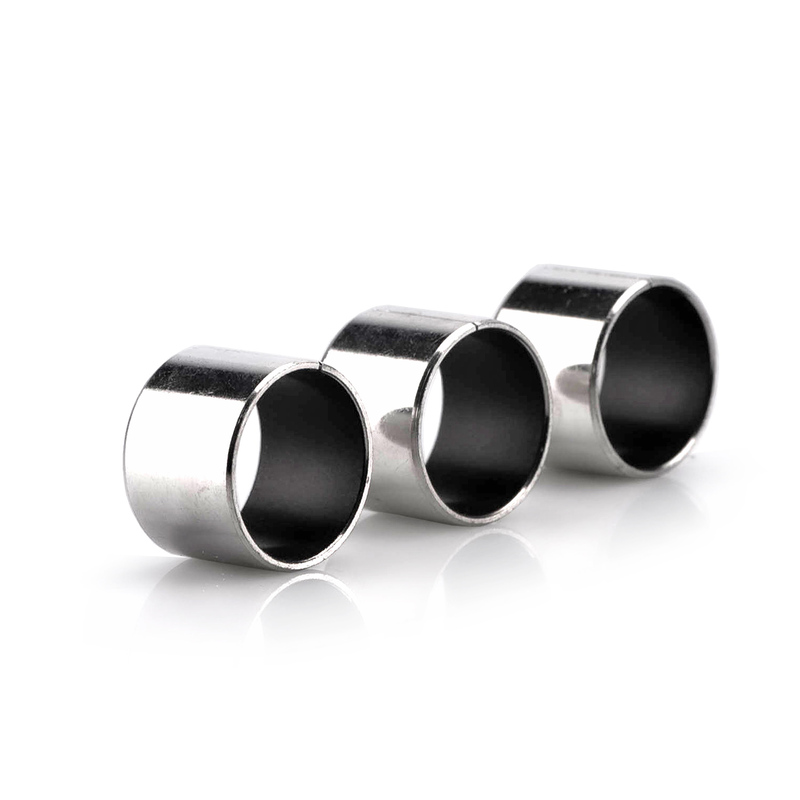
Depending on material type and application conditions, the lubricating media used in self-lubricating bearings can be either liquid or solid:
.jpg)
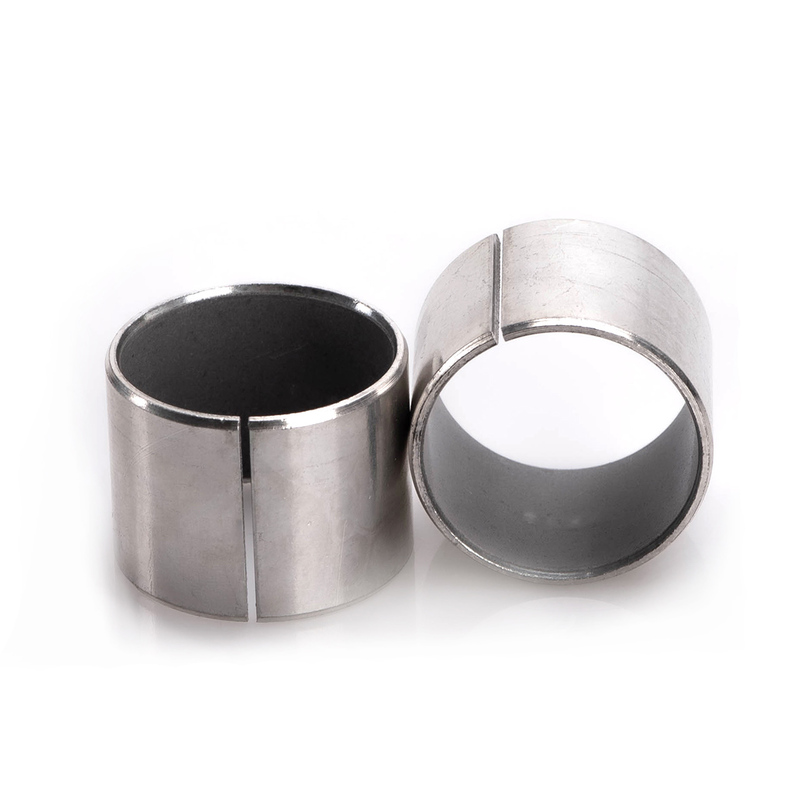
DU bearings are typically oil-lubricated. However, grease lubrication may be used in the following situations:
When operating under appropriate speed, contact area, viscosity, and oil volume conditions, DU bearings can withstand very heavy loads. The balance between these conditions is critical — if load or speed changes, the lubricant viscosity must be adjusted to compensate.
| Layer | DU PTFE Composite Bearing | DX POM Composite Bearing |
|---|---|---|
| 1 (Outermost Layer: Sliding Surface) | PTFE and Lead | POM (Modified Polyoxymethylene Resin) |
| 2 | Tin Bronze Powder (Sintered Layer) | Tin Bronze Powder (Sintered Layer) |
| 3 | Copper Layer | Copper Layer |
| 4 (Steel Backing) | Steel Backing | Steel Backing |
| 5 (Innermost Layer) | Copper Layer | Copper Layer |
| Performance Parameter | DU PTFE Composite Bearing | DX POM Composite Bearing |
|---|---|---|
| Compressive Strength (MPa) | 280 | 140 |
| Temperature Range (°C) | -195 ~ +270 | -20 ~ +100 |
| Coefficient of Friction | <0.20 | <0.20 (under lubricated conditions) |
| Wear Width (mm) | <0.55 | <4.5 (under lubricated conditions) |
| PV Value Limit (MPa·m/s) | 3.6 | 10 (with oil lubrication) |
| Wear Depth Limit (mm) | 0.05 | 0.50 |
| Thermal Conductivity (Kcal/M·hr·°C) | 2.41 | 2.03 |
| Linear Thermal Expansion Coefficient (per °C) | 27×10⁻⁵ | 5.1×10⁻⁵ |
| Lubrication Requirement | Dry running (no external lubrication required) | Boundary lubrication (performs better with grease) |
| Suitable Motion Type | Rotation, oscillation, reciprocation | High load / low speed, frequent start-stop cycles |
- Choose DU PTFE: When your application requires completely oil-free operation (dry running), a wide operating temperature range (especially extreme cold or above 100°C), or high compressive strength requirements (280 MPa).
- Choose DX POM: When your application has a grease supply, involves high load / low speed with frequent start-stop cycles (such as mold opening/closing or workholding fixtures), and the operating temperature is within -20°C to +100°C. DX extends service life under lubricated conditions.
For special operating conditions where DU and DX are not fully suitable, the following three material types offer targeted solutions:
Features a sintered bronze alloy or lead-free bronze alloy surface on a low-carbon steel backing, providing high specific load capacity — particularly suited for high-speed and impact conditions. Oil holes or grooves can be machined into the lining to improve lubricant retention.
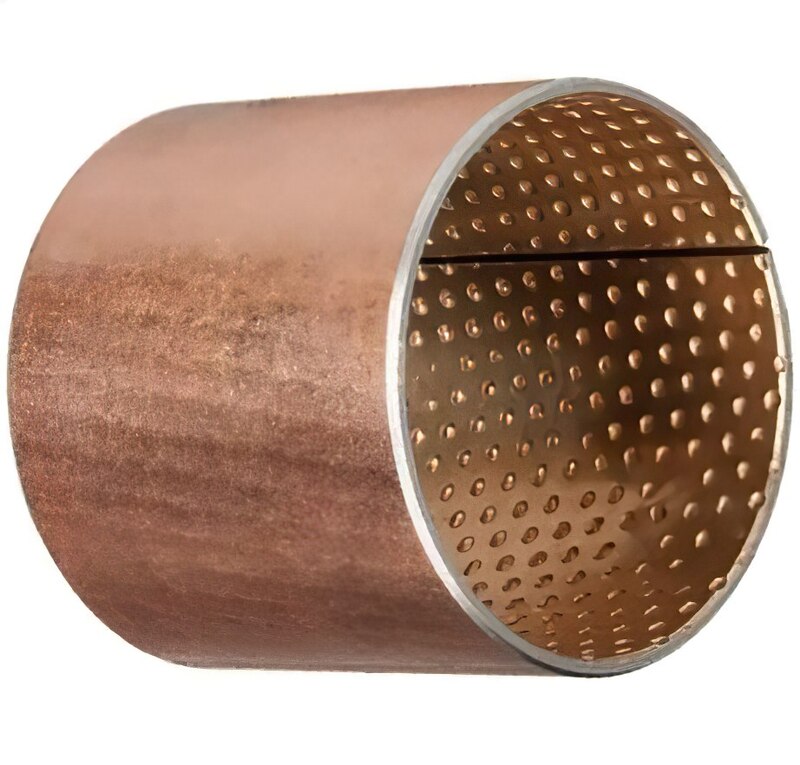%20(1).jpg)
Key Technical Characteristics:
Typical Applications: Truck chassis, agricultural machinery, construction machinery (applications requiring high speed and impact resistance with regular lubrication access).
Formed from cold-formed homogeneous bronze. Standard bearings feature diamond-pattern lubrication grooves on the bearing surface that act as lubricant reservoirs, rapidly forming a lubricating film during motion start-up to reduce breakaway friction.
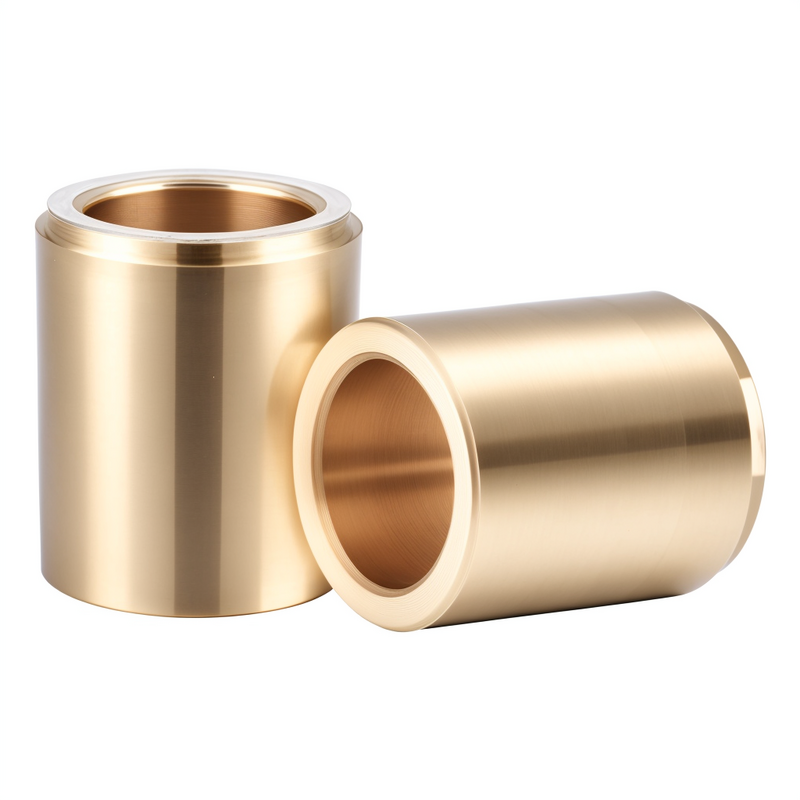
Key Technical Characteristics:
Typical Applications: Construction machinery (cranes), trucks, tractors, machine tools, mining machinery.
Combines solid lubricants with bronze to deliver the structural strength of bronze alongside the wear resistance of graphite, providing maintenance-free, low-friction operation — particularly suited for high-load and intermittent oscillating motion.
Key Technical Characteristics:
Typical Applications: Automotive production lines, water conservancy industry, dam gates, plastic molding machines (all applications requiring long-term stable operation without the ability to replenish lubricant).
Correct installation of self-lubricating bearings affects all other components within the drive assembly. Improper installation causes excessive vibration, increased runout, or damage to mating parts, inevitably damaging the components and their mating shafts. This increases downtime, and if the mating shaft is damaged, larger and more costly downstream problems can result.
| Wear Type | Cause Description | Prevention Measures |
|---|---|---|
| Abrasive Wear (Three-Body Wear) | Hard particles enter between lubricated surfaces, causing three-body wear; or asperities on one surface cut into the opposing surface, causing two-body wear | Ensure a clean installation environment |
| Lubrication Failure | Insufficient lubricant volume; oil film cannot be maintained, resulting in direct metal contact | Calculate required lubricant volume based on load; replenish regularly (for grease-type bearings) |
| High-Temperature Viscosity Breakdown | Lubricant viscosity drops at operating temperature; oil film cannot support the load, causing frictional heat generation and further viscosity breakdown — a vicious cycle | Select a lubricant viscosity grade appropriate for the operating temperature range |
| Issue Type | Cause Description | Prevention Measures |
|---|---|---|
| Rough Surface Wear | Journal surface roughness is too high, causing excessive friction against the bearing inner layer | Verify journal surface roughness meets specifications before installation |
| Unbalanced Impact Loading | Improper load distribution on supporting components causes repeated impact during rotation | Ensure proper alignment during installation and even load distribution |
| Journal Eccentricity (Oval/Egg-Shaped Journal) | Journal is out-of-round (elliptical eccentricity), causing friction to concentrate at the high points and accelerating localized wear | Verify journal roundness with measuring instruments before installation |
| Metal Fatigue | Improper metallurgy or material defects cause fatigue failure under repeated loading | Use certified materials meeting specifications; avoid substandard products |
| Selection Factor | Evaluation Notes | Impact on Material Selection |
|---|---|---|
| Pressure (P) | Operating load divided by bearing contact area (MPa) | High pressure → choose DU PTFE (280 MPa) or bimetal; low pressure → DX POM or bronze wrapped is sufficient |
| Speed (V) | Linear velocity of the shaft (m/s) | High speed → consider bimetal (with oil hole design); low-speed oscillation → solid lubricant embedded type |
| PV Value (Pressure × Velocity Product) | P (pressure, MPa) × V (speed, m/s) = PV value (MPa·m/s) | PV value must remain below the PV limit of the selected material (DU PTFE limit: 3.6 MPa·m/s) |
| Load Type | Static (steady) or dynamic (vibration, impact) | Impact loads → solid lubricant embedded or bimetal; steady rotation → DU PTFE |
| Lubrication Condition | Dry running, boundary lubrication, or full film lubrication | Dry → DU PTFE / solid lubricant embedded; boundary lubrication → DX POM; stable oil supply → bimetal or bronze wrapped |
The PV value (the product of pressure and velocity) is the most important composite indicator for evaluating whether a self-lubricating bearing selection is appropriate. An excessively high PV value means the heat generated by friction per unit time exceeds the material's heat dissipation capacity, leading to rapid wear or even thermal softening and material failure.
Using DU PTFE as an example, the PV value limit is 3.6 MPa·m/s. If your application has a pressure of 1.2 MPa and a linear velocity of 2.5 m/s, then PV = 1.2 × 2.5 = 3.0 MPa·m/s — below the limit, so DU PTFE can be safely used under these conditions.
It is important to note that the balance between these conditions is critical. If load or speed changes, the PV value must be re-evaluated to confirm it remains within the material's limit.
For applications requiring grease lubrication (particularly DX POM type or bimetal type), the following are key considerations for grease selection:
After determining the appropriate viscosity grade, additional criteria to consider include: oxidation stability, corrosion inhibition, wear protection, and water and air separation properties. Because self-lubricating bearings are used in a wide variety of applications, no single universal standard exists — selection depends on equipment design and operating conditions.
For extended re-greasing intervals and very heavy loads, solid additives such as molybdenum disulfide (MoS₂) or graphite may be incorporated. Solid additives work by mechanically preventing metal-to-metal contact under mixed-film and boundary lubrication conditions.
The PV value is the product of pressure (P, MPa) and velocity (V, m/s), representing the power density per unit area of the bearing. When the PV value exceeds the material's limit, it means the heat generated by friction exceeds the material's heat dissipation capacity — causing the bearing surface temperature to rise sharply, accelerating wear, and potentially causing PTFE and similar materials to soften and fail. The PV value limit for DU PTFE is 3.6 MPa·m/s. When selecting a bearing, always ensure the actual PV value remains below this limit.
DU PTFE uses PTFE as the sliding surface and can operate in completely dry (unlubricated) conditions with an extremely wide temperature tolerance (-195°C to +270°C) and higher compressive strength (280 MPa). DX POM uses modified polyoxymethylene resin (POM) and performs best under boundary lubrication conditions with grease; it has a narrower temperature range (-20°C to +100°C) and lower compressive strength (140 MPa). If your application cannot be regularly greased, or if the operating temperature exceeds 100°C, choose DU PTFE. If grease is reliably available and the application involves high load, low speed, and frequent start-stop cycles, DX POM may be considered
The wear depth limit for DU PTFE is 0.05 mm. Practical indicators include: abnormal noise (usually indicating the PTFE layer has worn through and metal-to-metal contact has begun), measurable increase in clearance, increased equipment vibration, or unstable operation. If wear is caused by journal eccentricity, rough surface finish, or improper installation, these issues must be identified and corrected at the same time as the bearing is replaced — otherwise the new bearing will wear out rapidly as well.
The two oil-free mechanisms are different: DU PTFE relies on PTFE forming a transfer film and is suited for a wide variety of motion types — rotation, oscillation, reciprocation — with a wide temperature tolerance, making it suitable for general self-lubricating applications. Solid lubricant embedded bearings, in contrast, have graphite or MoS₂ solid blocks embedded directly into a bronze matrix. They are specifically designed for extreme conditions where no oil film can form — such as very low speeds, high static loads, restart after prolonged shutdown, and applications such as dam gates in the water conservancy industry. If the PV value requirement exceeds the DU PTFE limit and operating speed is very low, solid lubricant embedded type is the more appropriate choice.
Please provide your question. We’ll find you with the best support options.