
Need Support?
Please provide your question. We’ll find you with the best support options.

Table of Contents
1. Which Cover Type Should You Choose for Your Application: ZZ, 2RS, or Open?
2. Clarification: ZZ, 2RS, RS, and Open Are Cover Types; C3 Is a Clearance Grade
3. What Do Z, ZZ, RS, 2RS, and Open Each Mean?
4. ZZ vs. 2RS: How Do Metal Dust Covers and Rubber Seals Differ?
5. What Applications Are Open Bearings Suited For?
6. What Is C3? How Does It Differ from Cover Types?
7. Lubrication, Speed, Temperature, and Cover Type Must Be Considered Together
8. How to Interpret 608ZZ, 608-2RS, and 608 Open: A Case Study
9. What Happens When You Choose the Wrong Cover Type, Lubrication, or Clearance?
If you already know your operating environment, you can refer directly to the table below.
If you are unsure which category your conditions fall into, we recommend reading further — each layer of the decision tree explains the underlying logic.
| Your Operating Environment | Recommended Choice | Key Reason |
|---|---|---|
| Dusty environment, higher temperatures (potentially above 120°C), no high waterproofing requirement | ZZ | Metal covers have better heat resistance than rubber and can block large-particle dust |
| Presence of moisture or liquid contaminants, temperature below 100°C, need for more complete sealing | 2RS | Rubber seals offer better water and dust protection than ZZ, but have limited heat resistance |
| Clean environment, requires continuous external lubrication replenishment, or specific assembly design | Open | Fully open design allows lubricant to flow freely in and out; not suitable for environments with contaminants or moisture |
| High-temperature, high-speed operation with high service life requirements (e.g., automotive alternators, engines) | C3 (combined with a cover suffix) | C3 is a clearance grade used to accommodate thermal expansion; must be combined with a cover suffix such as ZZ or 2RS |
| High ambient temperature with poor heat dissipation (e.g., dryers, paper-making machinery) | C3 or C4 (combined with a cover suffix) | Poor heat dissipation causes operating temperature to continuously accumulate; larger clearance is needed to compensate for thermal expansion |
Before reading this table, one thing must be understood first: C3 is not a cover type — it is a clearance grade.
This fundamental misunderstanding is the starting point for many incorrect bearing selection decisions. The next section explains this in detail.
The suffix codes in a bearing model number actually come from two completely different dimensions.
The first dimension is the cover type — that is, what material the covers on both sides of the bearing are made of. This determines the dust and water protection capability.
The second dimension is the clearance grade — that is, the amount of internal space between the rolling elements and the inner and outer rings. This determines how the bearing responds to thermal expansion and contraction.
ZZ, 2RS, RS, and Open are all cover type suffixes. C3, C4, and C2 are clearance grade suffixes. The two can be selected independently and can appear together in the same model number. For example, "608ZZC3" refers to a 608-size bearing fitted with double-sided metal dust covers (ZZ) and a C3 clearance grade.
Each suffix answers a different question: ZZ answers "can external contaminants get in?", while C3 answers "does the bearing have enough internal space to accommodate thermal expansion?"
Once you understand this classification, whenever you encounter any bearing model number, you can break the suffix into two separate questions:
1. What kind of sealing does my operating environment require?
2. What clearance grade do my operating conditions require?
| Suffix Code | Dimension | Meaning |
|---|---|---|
| Z | Cover type | Single-sided metal dust cover |
| ZZ (also called 2Z) | Cover type | Double-sided metal dust covers |
| RS | Cover type | Single-sided rubber seal |
| 2RS | Cover type | Double-sided rubber seals |
| Open (no suffix in model number) | Cover type | Fully open, no seal or dust cover |
| C3 | Clearance grade | Radial clearance Group 3, greater than standard value (C0) |
| C4 | Clearance grade | Radial clearance Group 4, greater than C3 |
Now that we understand the classification, let's look at the specific meaning of each cover type — Z is metal, RS is rubber.
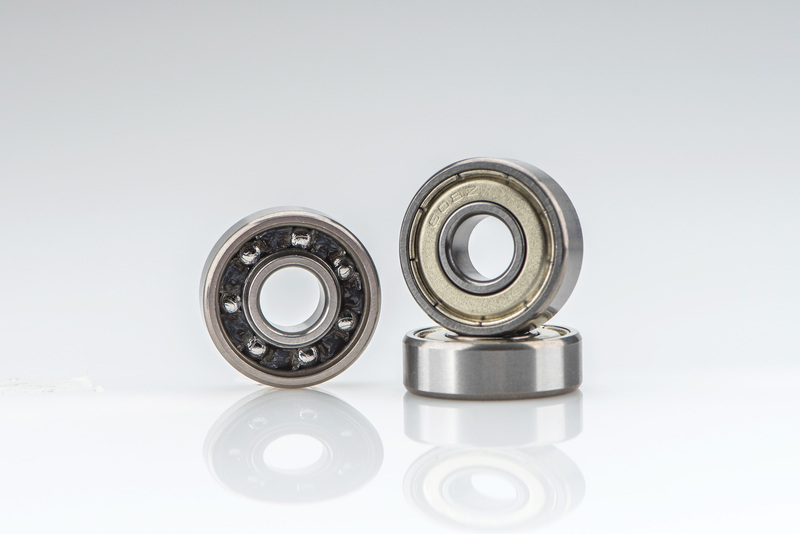
Z indicates that the bearing has a metal dust cover on one side only, with the other side remaining open. This design is suitable for applications that require single-sided protection while keeping the other side open as a lubrication access point. If the two sides of a piece of equipment face very different environmental conditions — one side near a contamination source, the other requiring periodic maintenance — the Z type offers greater flexibility.
.jpg)
ZZ indicates that both sides of the bearing are fitted with metal dust covers, effectively blocking dust and large-particle contaminants. It is important to note that ZZ is a non-contact design — there is a small gap between the metal cover and the inner ring. Its primary function is to block large foreign particles rather than provide complete sealing. This characteristic gives ZZ an advantage in high-temperature environments, as the non-contact design means the cover will not be affected by thermal expansion and contraction.
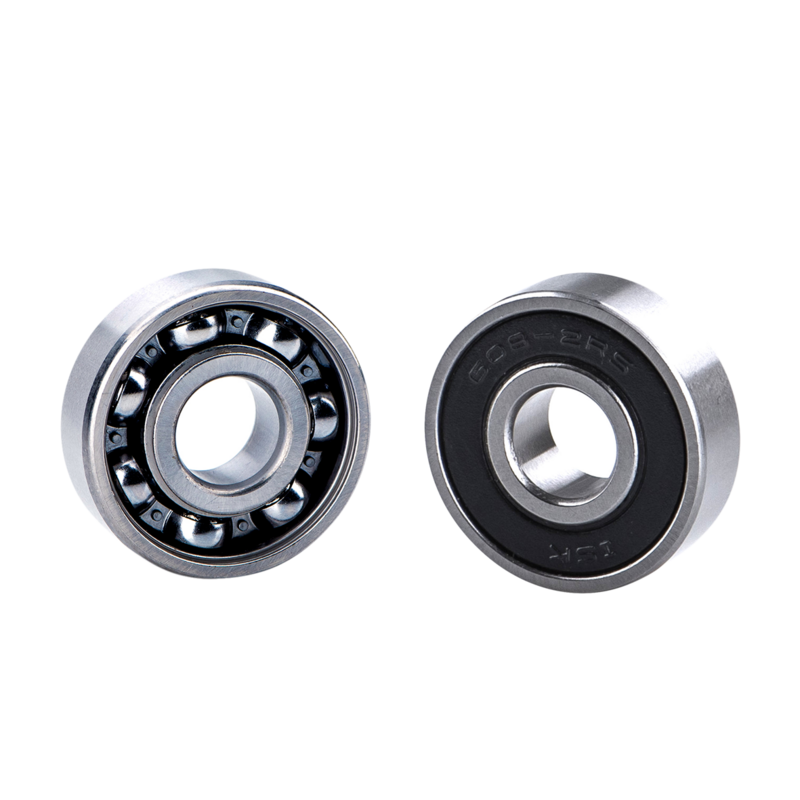
RS indicates that one side of the bearing is fitted with a rubber seal. The rubber sealing lip provides more effective protection against dust and moisture on that side compared to a single metal cover (Z type), offering more complete single-sided protection. This type is suitable for applications that require single-sided water and dust protection while allowing periodic lubrication replenishment from the other side.
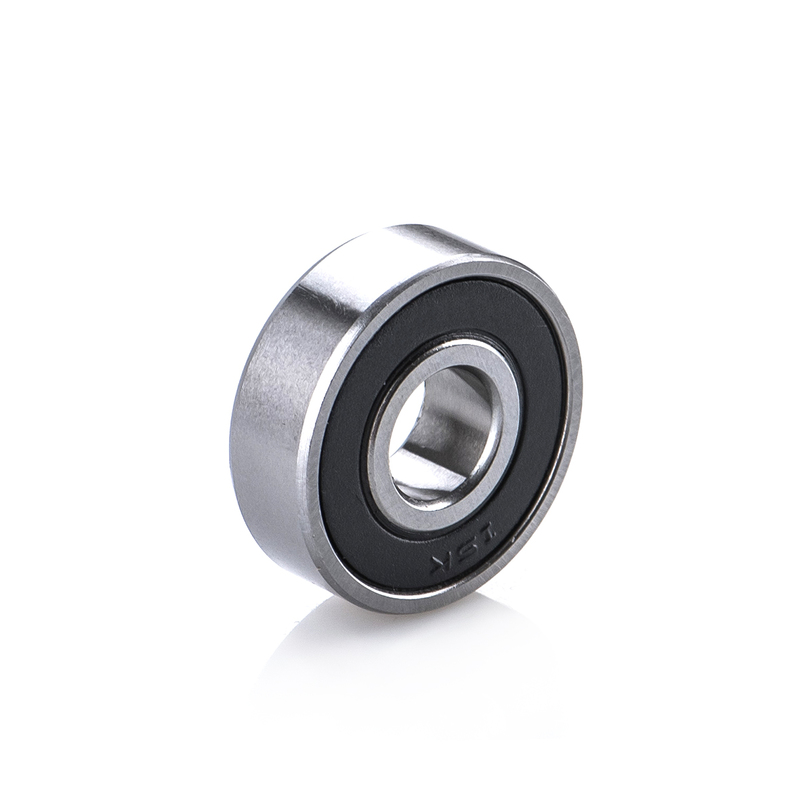
2RS indicates that both sides of the bearing are fitted with rubber seals, making it the most comprehensively waterproof and dustproof of the four cover types. The rubber lip directly contacts the rotating ring, forming a contact-type seal that effectively blocks external contaminants. It is suitable for environments requiring good sealing performance, such as household appliances, small motors, and outdoor devices.
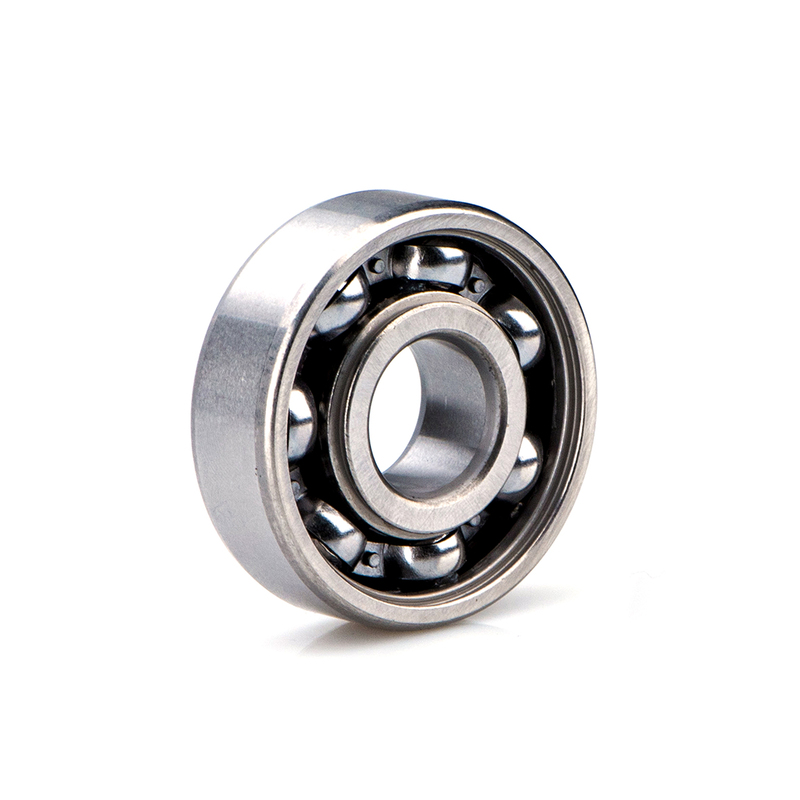
Open type bearings have a completely open design with no seals or dust covers of any kind, allowing lubricating oil to flow freely in and out. This type is generally not suitable for environments containing contaminants or moisture. It is better suited for relatively clean environments where continuous lubrication replenishment is required, or for equipment that already incorporates an independent external sealing mechanism and does not rely on the bearing's own covers for protection.
ZZ and 2RS are the two most commonly compared cover types, and they represent the primary decision point for most bearing purchases.
The fundamental difference between the two comes down to one question: does your equipment face a greater threat from dust and high temperatures, or from moisture and liquid contamination?
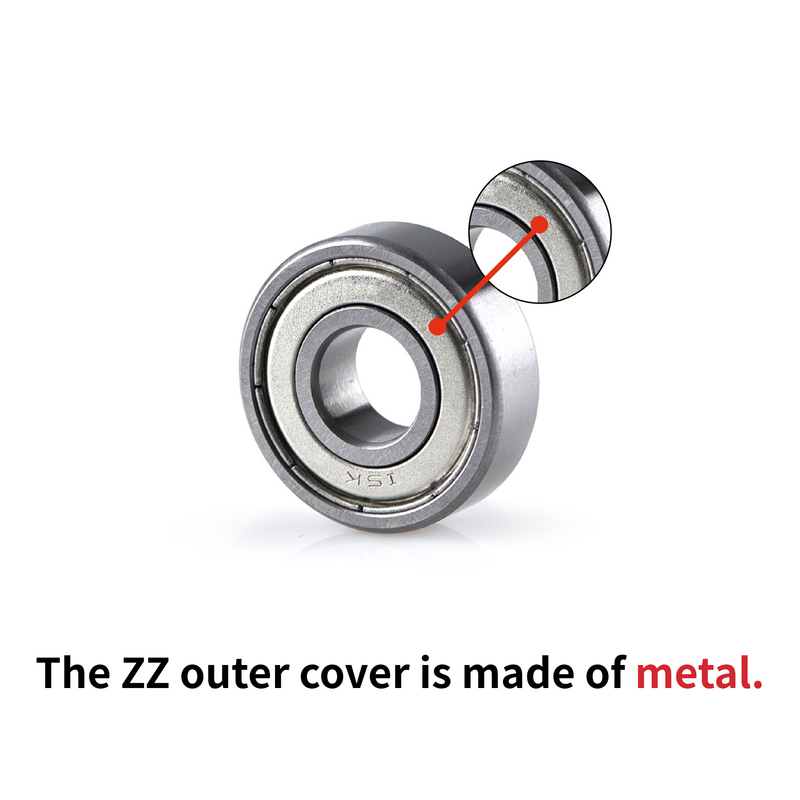
ZZ covers are made of metal. Because metal maintains better stability at high temperatures than rubber — resisting deformation and aging — ZZ-covered bearings are typically suitable for operating temperatures above 120°C, making them more reliable in high-temperature applications.
In terms of protection mechanism, the ZZ metal cover maintains a gap between itself and the inner ring, making it a non-contact design. Its primary function is to block large dust particles and foreign matter. This design also means that at high operating temperatures, the cover does not generate additional friction heat from contact, making it better suited for high-speed, high-temperature applications.
In industrial applications, ZZ-covered bearings are better suited for heat-resistant applications such as electric motors, blowers, and other equipment that must withstand higher temperatures.
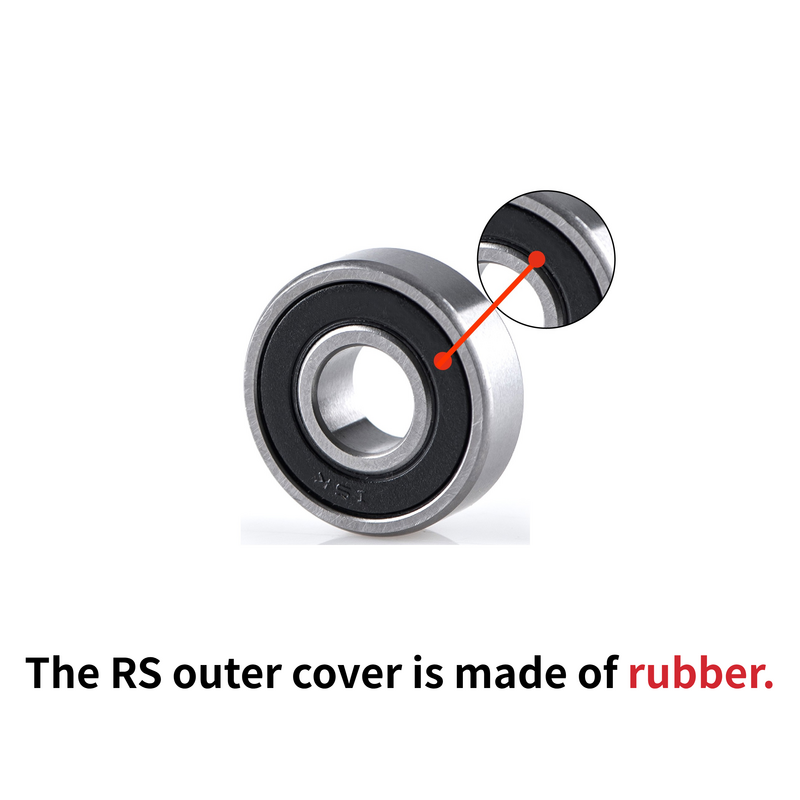
The 2RS cover uses rubber seals, providing superior water and dust protection that effectively blocks external contaminants. The rubber lip directly contacts the rotating ring, forming a contact-type seal that outperforms ZZ's non-contact metal cover in terms of water resistance and fine dust exclusion.
However, rubber has lower heat resistance than metal. Rubber can degrade or soften at high temperatures, and its sealing effectiveness may diminish as temperature increases. In general, the recommended operating temperature for 2RS covers should not exceed 100°C.
In terms of application, 2RS-covered bearings are well suited for environments requiring good sealing performance at relatively low temperatures, such as household appliances, small motors, and outdoor devices.
The core decision logic is: check temperature first, then check contamination type. If your equipment's operating temperature exceeds 100°C, ZZ is the more reliable choice, as rubber is less stable than metal at high temperatures. If the temperature is below 100°C and the environment contains moisture or fine contaminants, the contact-type rubber seal of 2RS will provide more complete protection.
.jpg)
Industrial applications involving higher temperatures, such as electric motors and blowers. The stability of metal materials allows it to maintain dust protection even under high-temperature conditions.
.jpg)
Environments requiring good sealing performance at relatively low operating temperatures, such as household appliances, small motors, and outdoor devices.
In terms of heat resistance, ZZ covers clearly outperform 2RS covers. Therefore, when an application involves higher operating temperatures, choosing ZZ-covered bearings is the more stable solution. However, if the priority is water and dust protection and operating temperatures are relatively low, 2RS covers are the more appropriate choice.
Open type bearings are completely unshielded, with no seals or dust covers of any kind, allowing lubricating oil to flow freely in and out. They are justifiably used in certain specific situations, but only when the operating environment meets specific conditions.
The conditions necessary for Open bearings to be appropriate typically include all of the following: first, the operating environment must be relatively clean, free from significant amounts of dust, cutting fluids, moisture, or other contaminants that could directly enter the bearing; second, the equipment design must allow for continuous or periodic external lubrication replenishment, and the open design permits lubricant to flow freely; or third, the equipment already incorporates an independent external sealing mechanism (such as an equipment housing or oil seal) that makes the bearing's own cover unnecessary.
Conversely, if any of the following conditions exist, Open type bearings should not be used: the environment contains dust, cutting fluids, moisture, or other contaminants; the installation location does not allow for periodic lubrication replenishment; the equipment requires low-maintenance or maintenance-free operation. In these situations, ZZ or 2RS should be considered based on the temperature conditions.
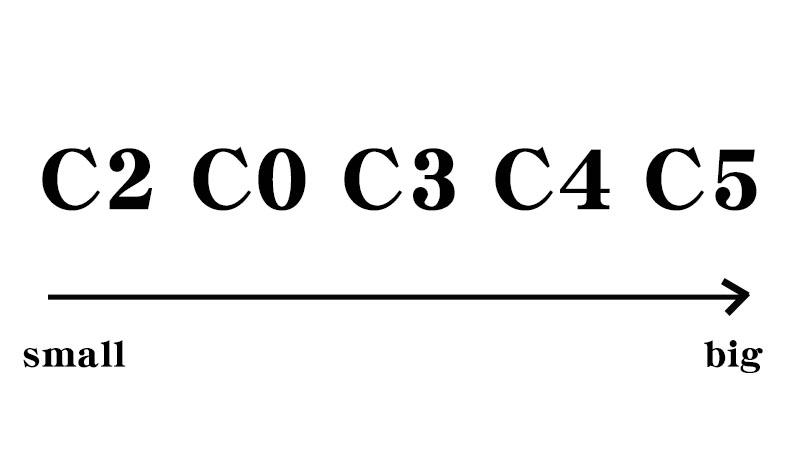
A C3 bearing, also referred to as a C3 clearance bearing, is a radial ball bearing with a specific internal clearance. The "C3" designation indicates that the bearing's internal clearance is larger than that of a standard bearing (C0 group), making it suitable for applications that require thermal expansion compensation or slight misalignment compensation.
Bearing radial clearance is classified into five groups in order from smallest to largest: C2, CM (a more precise version of the standard group C0), C0 (the Standard group, which is also the default when no clearance designation appears in the model number), C3, C4, and C5. The higher the number, the larger the clearance. Selecting C3 means selecting a larger internal space than the standard value.
You may wonder: why does a bearing's internal space need to be intentionally designed to be larger? The reason comes from two phenomena that occur during actual operation.
The first is temperature change. Machinery may undergo temperature fluctuations during operation. Metal expands when heated — the bearing's inner ring, outer ring, and rolling elements all expand together, causing the originally designed clearance to shrink. If a bearing is installed with standard clearance (C0), thermal expansion during high-temperature operation may reduce the clearance to near zero or even create a negative clearance condition, causing the rolling elements to be over-clamped, generating additional frictional heat, and creating a vicious cycle. C3 clearance reserves a larger internal space precisely so that the working clearance remains within an appropriate range even after thermal expansion.
The second is misalignment compensation. C3 bearing clearance can compensate for slight misalignment of mechanical components, reducing the risk of premature wear and damage. In addition, C3 clearance also helps reduce vibration, improving the stability and performance of the machinery.
The size of bearing clearance directly affects noise, vibration, temperature rise, service life, and mechanical motion characteristics during operation. Selecting the appropriate clearance is therefore critical. The following table shows clearance recommendations by application:
| Application Conditions | Typical Use Cases | Recommended Clearance |
|---|---|---|
| Strict noise and vibration control requirements, precise fit, high positioning accuracy | Instruments and measuring equipment, electric motors, low-noise small motors | C2, C0, and CM |
| Normal load, speed, and operating temperature | Power transmission machinery, reducers, and general-purpose machinery | C0 |
| High temperature, high speed, high service life requirements | Automotive alternators, engines | C3 |
| High ambient temperature with poor heat dissipation | Dryers, paper-making machinery, etc. | C3 and C4 |
| High temperature, high speed, heavy impact loads | Vibrating screens, high-speed gears | C4 |
| Inner and outer rings with interference fit, large interference, high temperature, poor heat dissipation | Vibratory road rollers, automotive rear wheels | C5 |
One important concept deserves special attention: although larger clearance may appear "safer," bigger is not always better. The source material points out that in actual use, the ideal working clearance should be close to zero clearance, because this is when the load distribution within the bearing is optimal and service life is longest. The rationale for selecting C3 is to ensure that the working clearance after thermal expansion falls within near-optimal range — not to maintain a permanently large clearance during operation. If your equipment does not need to compensate for thermal expansion, C3 is unnecessary; standard clearance (C0) is sufficient for general applications.
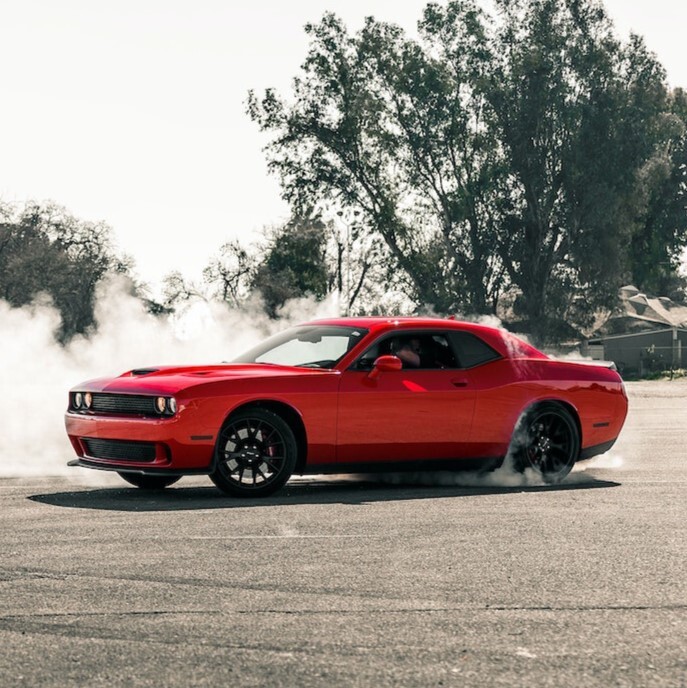
C3 clearance is widely used in vehicle components such as wheel hubs, drivetrain systems, and engines. Its ability to accommodate thermal changes and correct misalignment meets clearly defined functional requirements in the automotive field.
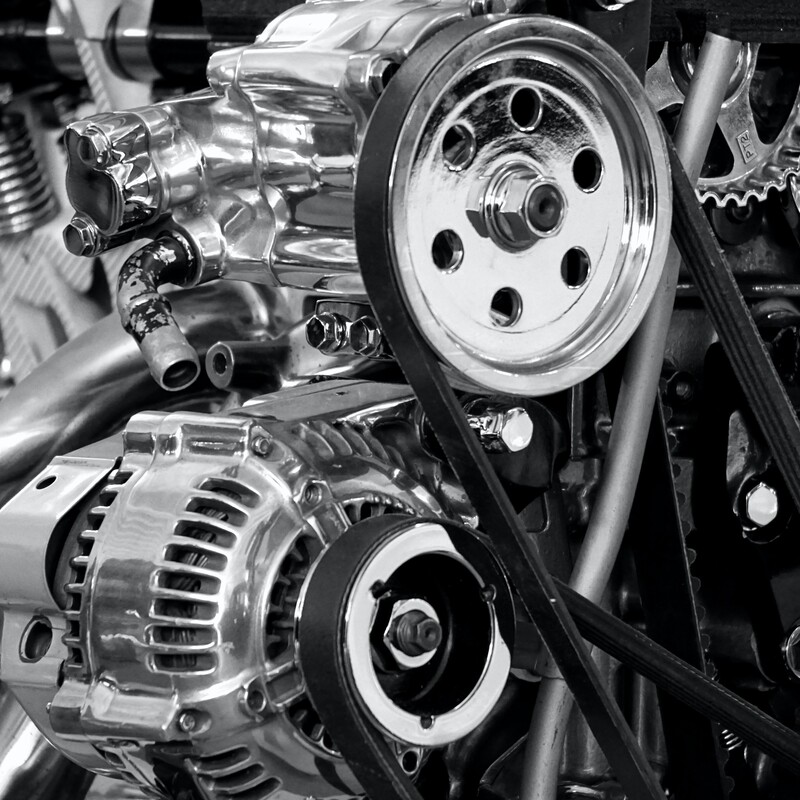
Manufacturing and industrial machinery — including conveyor belts, pumps, and gearboxes — rely on C3 clearance to ensure smooth operation under demanding conditions, even when subject to temperature fluctuations.

In aircraft engines, landing gear, and control systems, precision and reliability are critical. C3 clearance makes an important contribution to safety and performance.
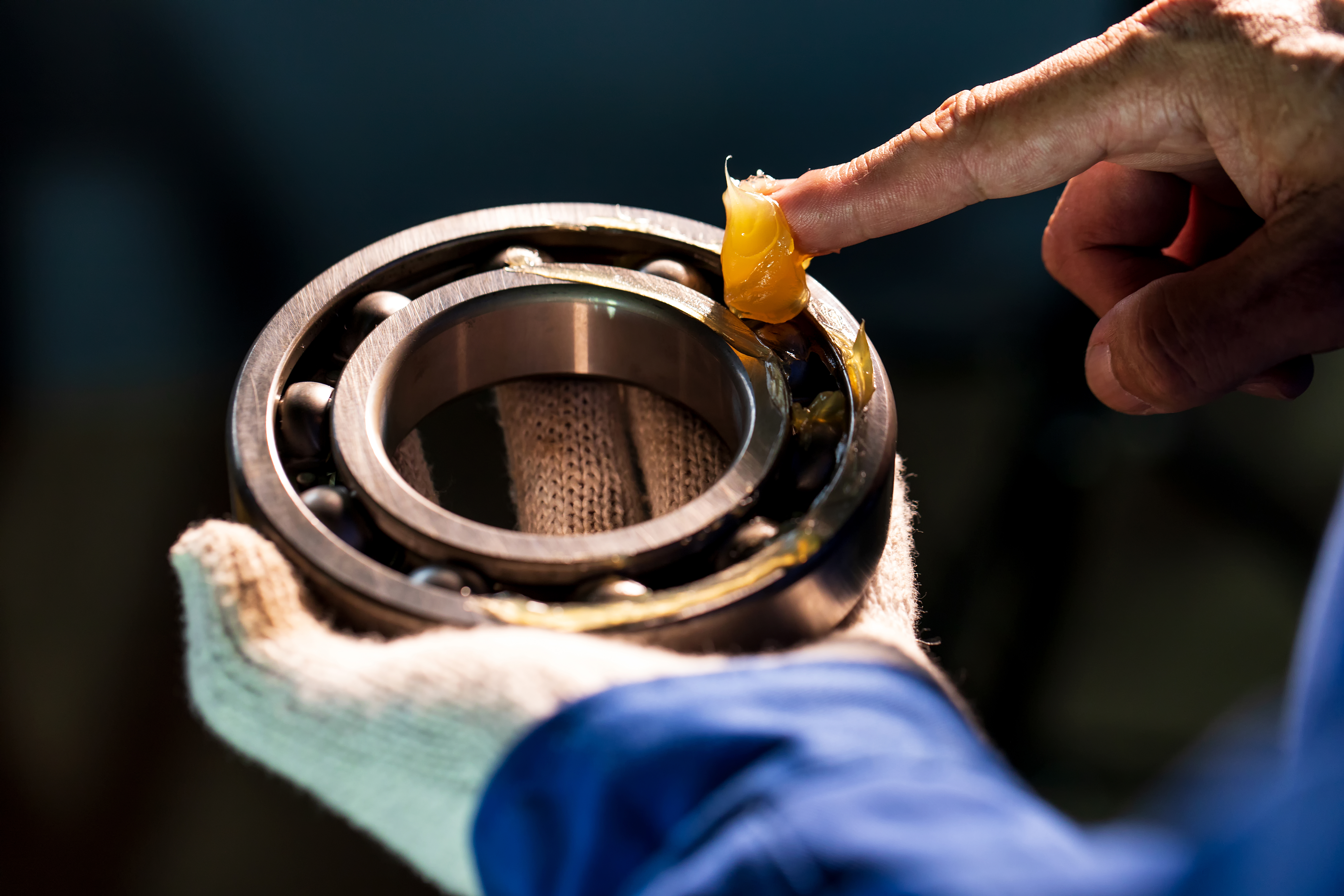
Cover type selection cannot be discussed in isolation from lubrication conditions, because different cover types directly determine how lubricant is replenished and retained. The source material explicitly states that one of the factors to consider when selecting bearing lubricants is compatibility with bearing materials and seal types. In other words, your choice of cover type determines what properties your lubricant needs to have.
Temperature is the first dimension. The operating temperature range of the bearing directly affects lubricant selection. High-temperature environments require lubricants with high-temperature resistance, while low-temperature environments require lubricants that maintain fluidity under cold conditions. If your equipment operates at high temperatures and uses ZZ covers, the corresponding grease must also have adequate high-temperature tolerance.
Speed is the second dimension. The rotational speed of the bearing affects the viscosity selection of the lubricant. High-speed bearings require lubricants that can withstand high rotational speeds — excessively high-viscosity grease in a high-speed environment will actually generate additional churning heat. Low-speed bearings have relatively lower speed demands on the lubricant.
Load rate is the third dimension. The load borne by the bearing affects lubricant selection. In heavy-load environments, the lubricant must have greater pressure resistance to maintain an effective oil film even under compressive stress.
Moisture is the fourth dimension. If the bearing operates in a wet or high-humidity environment, a lubricant with water-resistant properties must be used to prevent lubrication failure and bearing corrosion. This factor is also directly related to cover type selection — if your environment has heavy moisture, choosing 2RS is necessary, and the grease itself must also have water-resistant properties.
Grease is a semi-solid lubricant composed of base oil, a thickener, and additives. It is relatively straightforward to apply, offers good sealing and retention, provides lasting lubrication, and can withstand heavy loads and high temperatures. It is widely used in automotive, industrial machinery, and household appliances, and is the most common lubricant form for ZZ and 2RS sealed bearings.
Oil (liquid lubricating oil) is typically mineral oil or synthetic oil. It provides excellent lubrication, achieves low friction and superior heat dissipation, and is particularly well suited for high-speed applications. These oils come in various viscosity grades depending on operating conditions. Open type bearings more commonly use oil lubrication, as the open design allows oil to circulate in and out freely.
Solid lubricants such as graphite, molybdenum disulfide (MoS₂), and polytetrafluoroethylene (PTFE) are used in specialized applications where conventional liquid lubricants are unsuitable or impractical — for example, in aerospace, marine, and extreme high-temperature environments.
The 608 series is used as a case study because it is one of the most common miniature Deep Groove Ball Bearing models, widely used in power tools, skateboards, 3D printers, and other equipment. We will first confirm the basic dimensions, then explain the differences and appropriate applications for each suffix variant.
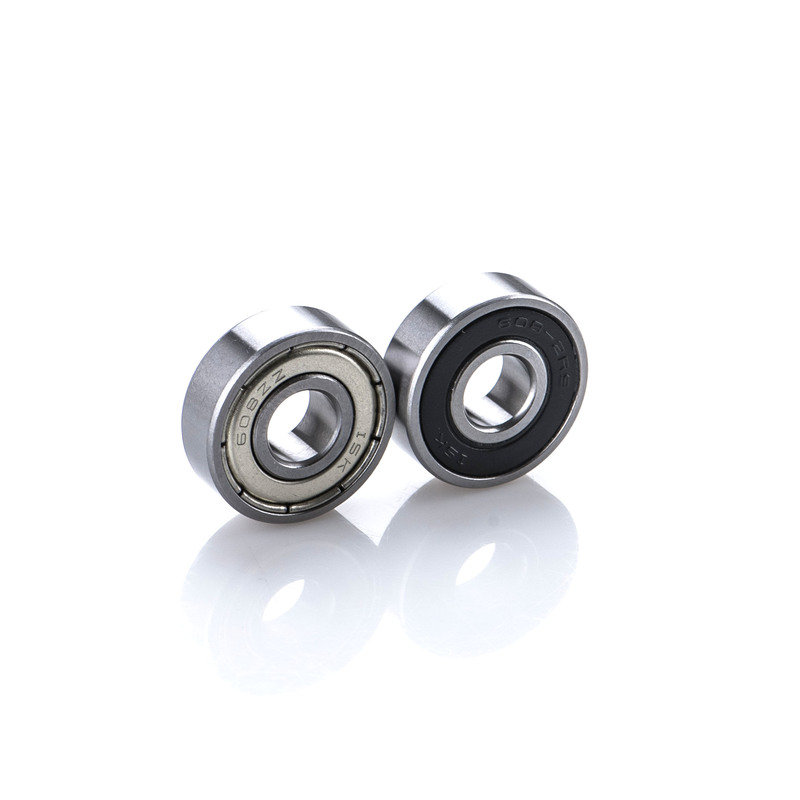
The basic dimensions of the 608 series are identical across all Z, ZZ, RS, 2RS, and Open variants. The model suffix only changes the cover type and has no effect on installation dimensions.
| Bore Diameter (d) | 8 mm |
|---|---|
| Outer Diameter (D) | 22 mm |
| Width (B) | 7 mm |
| Weight | 11.8 g |
| Dynamic Load | 335 kgf |
| Static Load | 140 kgf |
When selecting a 608 series bearing for a power tool or motor, the decision logic is as follows:
Choose 608ZZ when the equipment operates at higher temperatures (e.g., a motor that may exceed 100°C during operation), the primary environmental concern is dust rather than moisture, and you want to reduce maintenance frequency. The metal dust cover maintains stability at high temperatures, and the non-contact design produces lower friction torque — making it well suited for high-temperature operation where some dust protection is needed.
Choose 608-2RS when the operating environment contains moisture, humidity, or fine contaminants (such as outdoor equipment or machinery near food-processing water sources), and the operating temperature is below 100°C. The contact-type rubber seal provides more complete sealing, making it appropriate for applications that require higher protection levels without exceeding temperature limits.
Choose 608 Open when the equipment is installed in an environment that already has an external sealing mechanism (such as an oil seal or sealed housing), or when continuous external lubrication replenishment is required and the environment is relatively clean, with no contaminants that could directly enter the bearing.
Choose 608ZZC3 or 608-2RSC3 when, in addition to the cover type conditions described above, the equipment simultaneously operates at high temperature and high speed with high service life requirements (such as automotive components or industrial high-speed equipment). In this case, after selecting the appropriate cover type, add the C3 clearance to compensate for thermal expansion.
Regardless of which variant you choose, the basic installation dimensions of the 608 are the same: bore diameter 8 mm, outer diameter 22 mm, width 7 mm. The suffix difference does not affect the installation fit — only the protection capability and operating characteristics.
An incorrect bearing selection does not necessarily cause immediate equipment failure, but it will accelerate bearing wear and shorten service life — ultimately causing a failure at the worst possible time. The following describes five common wrong-selection scenarios and their potential consequences.
The ZZ metal dust cover is a non-contact design, with a gap between the metal cover and the inner ring. This means fine moisture or liquid contaminants can still seep through this gap into the bearing interior. Once water enters, the best case is that it dilutes the grease and reduces lubrication effectiveness; the worst case is that it directly causes internal bearing corrosion, shortening service life. In environments with moisture, the protection offered by ZZ is clearly insufficient — 2RS with its contact-type rubber seal should be used instead.
Rubber seals can degrade or soften at high temperatures, and their sealing effectiveness may diminish as temperature increases. Once the rubber ages from high-temperature exposure, the sealing lip loses its elasticity, and what was previously a tight contact-type seal against the rotating ring begins to develop gaps, causing grease to leak. Once grease is lost, the bearing's lubricant film is compromised, leading to increased friction, abnormal noise, and premature failure. In environments exceeding the recommended temperature (100°C), ZZ with its superior heat resistance should be selected instead.
The completely open design allows contaminants to enter the bearing interior directly. Once dust, cutting fluids, or moisture become mixed into the grease, they not only dilute the lubrication effect — the infiltrated particles also directly participate in raceway contact, accelerating abrasive wear. This type of failure tends to be faster and more direct in causing bearing failure than insufficient sealing.
When a bearing operates at high temperatures, metal thermal expansion causes the clearance to shrink. If standard clearance (C0) is used at installation, thermal expansion during operation may reduce the working clearance to near zero or even create preload, causing the rolling elements to be subjected to excessive clamping force. This not only increases frictional heat but also causes the bearing temperature to rise further, creating a vicious cycle that accelerates wear. For high-temperature, high-speed applications with high service life requirements, C3 clearance should be considered.
Larger clearance is not always better. In precision applications with strict noise and vibration control requirements (such as instruments or low-noise small motors), excessive clearance actually increases the range of motion of the rolling elements within the raceway, causing slight wobble during rotation and generating noise and vibration that affect equipment precision. Such applications should use C2 or C0 with smaller clearance values.
In terms of overall dust and water protection, the contact-type rubber seal of 2RS outperforms the non-contact metal dust cover of ZZ. The ZZ metal cover maintains a gap with the inner ring and primarily blocks large particles; the rubber lip of 2RS directly contacts the rotating ring, providing more complete protection. However, if the operating temperature exceeds 100°C, rubber is prone to aging, and ZZ's heat-resistant stability becomes the more critical consideration. Simply put: choose 2RS for water and dust protection; choose ZZ for high-temperature environments — temperature is the primary dividing line between the two.
C3 is not a cover type — it is a clearance grade designation indicating that the bearing's internal radial clearance is greater than the standard value. It can appear in the same model number as ZZ, 2RS, Open, and other cover types — for example, "608ZZC3." If you simply request a "C3 bearing," you generally also need to specify the cover type, such as "608ZZC3" or "6204-2RSC3," to fully describe the bearing's specifications.
Yes. The basic installation dimensions of the 608 series (bore diameter 8 mm, outer diameter 22 mm, width 7 mm) are identical across ZZ, 2RS, and Open variants. The model suffix only affects the cover type (protection capability) and does not affect the installation fit dimensions. If your equipment currently uses 608ZZ and you want to switch to 608-2RS, the replacement is a direct fit — no adjustment to bore or shaft diameter is required.
Not recommended. Open type bearings have a completely open design with no sealing of any kind, and are generally not suitable for environments containing contaminants or moisture. If the application involves moisture, humidity, dust, or other contaminants, ZZ or 2RS should be selected — use the temperature conditions to determine which is more appropriate.
Because metal expands at high temperatures. When a bearing operates at high temperature and high speed, the inner ring, outer ring, and rolling elements all expand from the heat, causing the originally designed clearance to shrink. If standard clearance (C0) is used at installation, the clearance after thermal expansion may become too small, or even generate excessive preload, increasing frictional heat and shortening service life. C3 clearance is larger than C0 precisely so that the working clearance after thermal expansion remains within an appropriate range — not so that the clearance stays large at all times.
material: ZZ-covered bearings are made of metal, which has greater stability than rubber at high temperatures and can typically be used above 120°C. The recommended operating temperature for 2RS covers should not exceed 100°C, because rubber is prone to degradation or softening at high temperatures, and its sealing effectiveness diminishes as temperature rises. Therefore, in environments exceeding 100°C, ZZ is the relatively more reliable choice. It should be noted that high-temperature applications also require selecting a heat-resistant grease — both factors must be considered together.
A bearing model number is primarily composed of a basic designation plus prefixes and suffixes that identify dimensions, sealing, and special design features. The basic designation determines the type and size (e.g., 6204 = series 62, bore code 04 = 20 mm bore diameter). Suffix codes indicate sealing (Z/ZZ/RS/2RS/Open), clearance (C2/C0/C3/C4), and other characteristics. Remember two rules: the number of letters indicates how many sides are covered (Z = single-sided metal cover, ZZ = double-sided metal covers, RS = single-sided rubber seal, 2RS = double-sided rubber seals), and the number after C indicates clearance size — the higher the number, the larger the clearance (C2 < C0 < C3 < C4 < C5). For more detailed information
Please provide your question. We’ll find you with the best support options.