
Need Support?
Please provide your question. We’ll find you with the best support options.

Self-lubricating bearings (plain bearings) and standard bearings (rolling bearings) differ fundamentally in their operating principles, load capacity, speed limitations, maintenance requirements, and installation methods. This article focuses on comparison and decision-making, helping engineers and procurement professionals determine which bearing type best suits their specific equipment application.
→ If you are not yet familiar with the basic definition of self-lubricating bearings, we recommend reading first: Self-Lubricating Bearing (Bushing) Technical Guide: Principles, Materials & Application Evaluation
Table of Contents
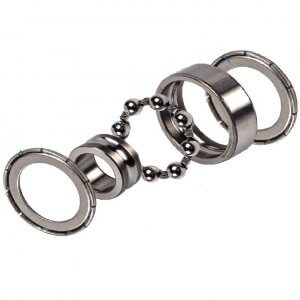
The primary function of a bearing is to facilitate motion between two components while reducing friction. Standard rolling bearings feature two surfaces that roll against each other, allowing two mating parts to move smoothly with minimal friction.
Bearings serve two core functions:
| Bearing Type | Motion Type | Typical Applications |
|---|---|---|
| Ball Bearing | Rolling (balls) | Home appliances, conveyor systems, high-speed rotating equipment |
| Needle Roller Bearing | Rolling (slender rollers) | Automotive engines, aerospace components (limited radial space) |
| Thrust Bearing | Rolling (axial force) | Gearboxes, equipment requiring axial load management |
| Tapered Roller Bearing | Rolling (tapered rollers) | Automotive wheels (handling both radial and axial loads simultaneously) |
| Self-Aligning Roller Bearing | Rolling (self-adjusting angle) | Heavy equipment requiring simultaneous heavy radial loads and impact absorption, where shaft eccentricity or installation misalignment exists |
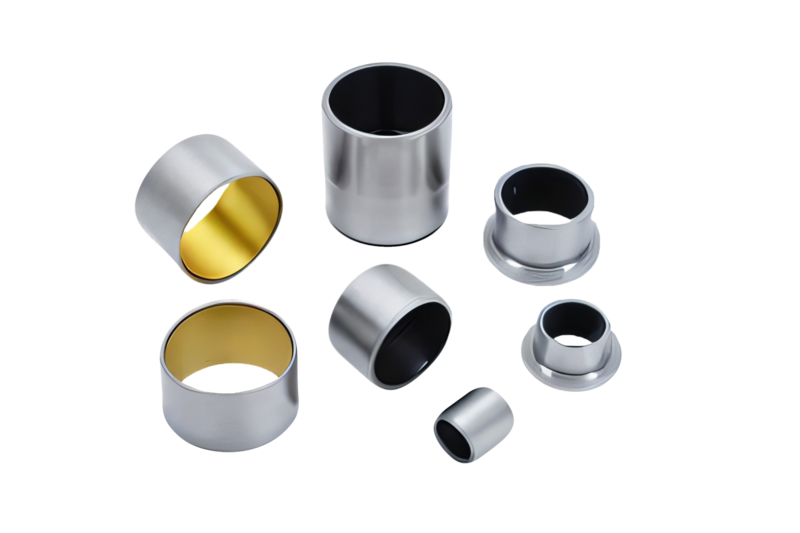
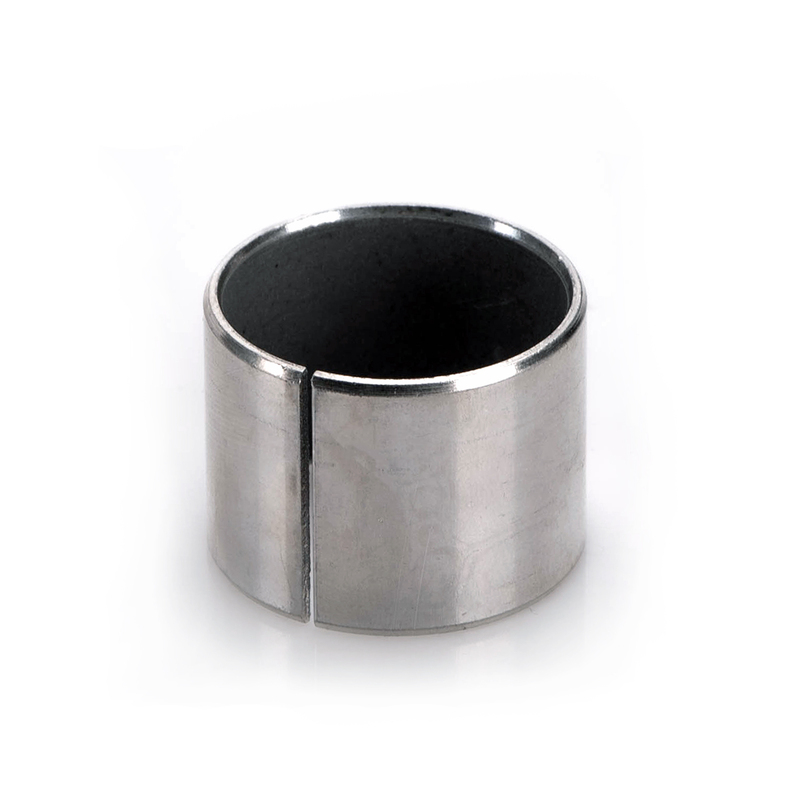
The defining characteristic of self-lubricating bearings (dry bearings, DU bearings, sleeve bearings, bushings) is that motion between the shaft and the bearing is achieved through sliding, not through rolling elements. This design is suitable for lower-speed applications and can operate within a more compact space.
.jpg)
Self-lubricating bearings typically consist of a steel backing, a porous bronze layer, and an inner layer of self-lubricating material such as PTFE:
Self-lubricating bearings can operate without any external liquid lubricant. Some models feature grease-storage grooves in their design, but they function normally even without oil — this is one of the most significant maintenance differences compared to rolling bearings.
| Criteria | Self-Lubricating Bearing (Sliding) | Standard Bearing (Rolling) |
|---|---|---|
| Contact Interface | Direct sliding between shaft and inner bearing layer, separated by a solid lubricating film | Rolling between shaft and rolling elements, separated by rolling elements and oil film |
| Friction Type | Sliding friction, reduced by low-friction-coefficient materials (PTFE, etc.) | Rolling friction, inherently lower than sliding friction |
| Suitable Load Type | Capable of handling high impact loads and vibration loads; suitable for intermittent or oscillating motion | High load capacity; suited for continuous high-speed rotation; handles both radial and axial loads |
| Criteria | Self-Lubricating Bearing (Sliding) | Standard Bearing (Rolling) |
|---|---|---|
| Load Capacity | Can withstand high static loads and impact loads; DU PTFE compressive strength up to 280 MPa | High load capacity; suited for high dynamic loads, especially at high speed and high precision |
| Speed Range | Suitable for low to medium speeds; performance limited at high speeds due to frictional heat from sliding | Can handle high-speed rotation; maximum speed rating significantly higher than plain bearings |
| Impact Tolerance | Large contact area distributes impact; excellent impact resistance | Rolling elements may be damaged under high impact; impact-resistant types should be selected |
| Precision | Sliding design offers relatively lower running precision | High running precision; suited for precision machining, instruments, and other high-accuracy applications |
| Criteria | Self-Lubricating Bearing (Sliding) | Standard Bearing (Rolling) |
|---|---|---|
| Structural Complexity | Single-piece cylindrical sleeve; extremely simple structure; no cage or rolling elements required | Composed of four parts: inner ring, outer ring, rolling elements, and cage — more complex |
| Installation Space | Thin-wall design; compact; suitable for space-constrained or lightweight applications | Requires more radial and axial space to accommodate the full structure |
| Ease of Installation | Simple structure; easy press-fit installation; split design ideal for applications where the shaft cannot be removed | Requires precise fitting tolerances; higher installation accuracy demands |
| Misalignment Compensation | Can compensate for a certain degree of misalignment; suitable for applications where installation accuracy is limited | Typically requires precise alignment (except self-aligning types) |
| Criteria | Self-Lubricating Bearing (Sliding) | Standard Bearing (Rolling) |
|---|---|---|
| Lubrication Method | Relies on solid lubricating materials (PTFE, graphite, etc.) for self-lubrication; no liquid lubricant required | Requires periodic replenishment of grease or oil |
| Maintenance Requirement | Typically maintenance-free; significantly reduces equipment maintenance costs and downtime | Requires regular lubrication maintenance; neglect will shorten service life |
| Food / Medical Hygiene Environments | Oil-free design; no contamination risk; meets stringent hygiene standards | Lubricant may contaminate products; food-grade grease must be used |
| High-Temperature Environments | DU PTFE withstands -195°C to +270°C; suitable for a wide temperature range | Grease performance degrades at high temperatures; high-temperature-rated products must be selected |
| Corrosive / Humid Environments | PTFE and similar materials are inherently chemically resistant; suitable for marine and hydraulic structure environments | Steel rolling elements require rust protection; stainless steel types must be selected for corrosive environments |
Based on the four-dimension analysis above, the following recommendations are provided for common equipment scenarios:
| Application Scenario | Recommended Choice | Reason | |
|---|---|---|---|
| Automotive Suspension Systems, Steering Knuckles, Chassis Joints | Self-Lubricating Bearing (DU/DX) | Reciprocating and oscillating motion, impact load absorption, space-constrained, maintenance-free | |
| High-Speed Precision Machine Tool Spindles | Rolling Bearing (Ball Bearing) | High-speed rotation required, high precision demanded, lower rolling friction coefficient | |
| Food Conveyors, Packaging Equipment | Self-Lubricating Bearing (PTFE Type) | Oil-free design, no grease contamination risk, meets hygiene requirements | |
| Agricultural Machinery (Seeders, Harvester Linkages) | Self-Lubricating Bearing (Bimetal or DU) | Harsh outdoor environments, high impact loads, maintenance-free required | |
| Dam Gates, Hydraulic Valves | Self-Lubricating Bearing (Solid Lubricant Embedded Type) | Very low speed, high static load, humid and corrosive environment, completely oil-free | |
| Small Electric Motors, Fans | Sleeve Bearing (Self-Lubricating) |
|
|
| Fitness Equipment Pivot Joints | Self-Lubricating Bearing (DU) | Low to medium speed rotation, maintenance-free, low cost, compact space | |
| Marine Propeller Shaft Support | Self-Lubricating Bearing | Humid seawater environment, corrosion resistance required; self-lubricating materials are inherently chemically resistant |
Key Principles:
- High speed, high precision → Favor rolling bearings
- Low speed, maintenance-free, space-constrained → Favor self-lubricating bearings
- Heavy loads requiring extremely high impact resistance and fatigue strength (e.g., truck chassis) → Favor bimetal bushings
No, they cannot fully replace each other. The two are designed for different purposes: self-lubricating bearings are suited for low-speed, moderate-load, impact-load, maintenance-free, and space-constrained applications; rolling bearings are suited for high-speed, high-precision, and high-dynamic-load applications. Selection should be based on the actual speed, load, precision, and maintenance conditions of the equipment — not simply on cost or size.
Not necessarily. Under conditions where self-lubricating bearings are appropriate (low speed, moderate load, impact environments), their wear rate is extremely low and service life is comparable to ball bearings. Moreover, because they are maintenance-free, they actually reduce the risk of premature failure caused by neglected lubrication. Ultimately, service life depends on whether the selection was correct and the quality of installation.
Please provide your question. We’ll find you with the best support options.