
 TOP
TOPNeed Support?
Please provide your question. We’ll find you with the best support options.

Bearings play a critical role in mechanical engineering and are indispensable components in many mechanical devices.
However, there are three main types of bearings in the market—
Axial Bearings, Radial Bearings, and Radial Axial Bearings, each with its unique design purpose and application scenarios.
This article will provide an in-depth discussion of the functions, differences, applications, and selection considerations of these three bearing types to help you better understand and utilize this critical component.
Axial bearings play a key role in mechanical equipment and industrial applications, as they are capable of withstanding axial forces to facilitate smoother rotational motion.
Axial bearings are designed to withstand axial forces, which are forces applied along the axis direction. When the load is applied along the bearing's axial direction, bearings can provide efficient support and reduce friction, thereby achieving smooth operation.
Axial force refers to the force applied along the bearing's axial direction. When this type of load is applied, specially designed axial bearings provide efficient support and reduce friction during the rotation process.
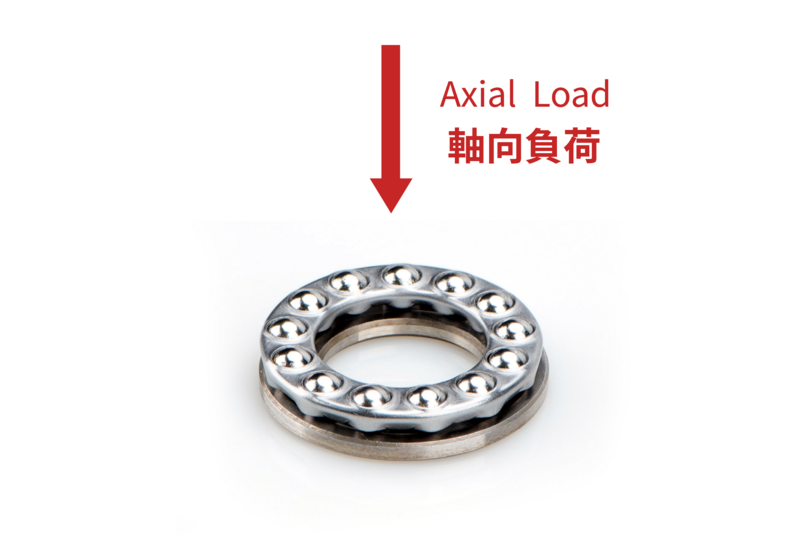
Axial bearings can effectively withstand thrust loads along the axial direction.
Radial bearings are widely used rolling bearings with applications machine tool spindles, applications requiring combined load support
The primary function of radial bearings is to withstand radial loads perpendicular to the axial direction. When the load is applied perpendicular to the bearing's axial direction, radial bearings provide stable support and reduce friction, thereby achieving smooth operation.
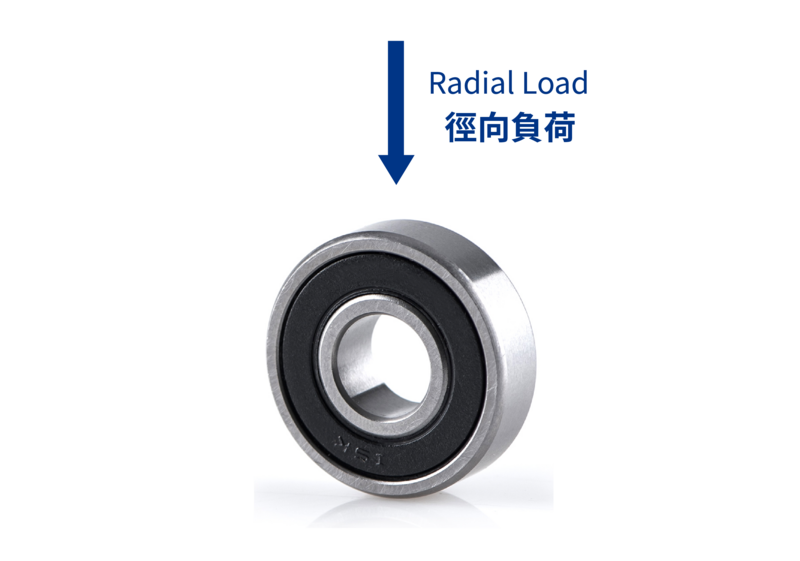
Radial bearings can effectively withstand lateral loads perpendicular to the axial direction.
Radial Axial Bearings are important components used to support and position rotating mechanical parts.
They can withstand both axial and radial loads from two directions, enabling mechanical components to operate smoothly and withstand external forces.
This load-bearing capability makes Radial Axial Bearings widely used in various applications, including automotive, aerospace, and industrial machinery fields.
The unique advantage of Radial Axial Bearings is their ability to simultaneously handle two types of loads, which is essential in many complex mechanical systems.
|
Comparison Items |
Axial Bearings |
Radial Bearings |
Radial Axial Bearings |
|---|---|---|---|
|
Direction of Load |
Along the axial direction (Axial) |
Perpendicular to the axial direction (Radial) |
Both Axial and Radial |
|
Primary Function |
Support axial loads |
Support radial loads |
Simultaneously support axial and radial loads |
|
Load Capacity |
Usually has higher load capacity |
Usually has moderate load capacity |
Usually has higher load capacity |
|
Installation |
Relatively easy to install |
Relatively easy to install |
Requires specific installation methods and positioning |
|
Application Range |
Relatively specialized applications in mechanical engineering |
Common applications in mechanical engineering |
Relatively specialized applications in mechanical engineering |
|
Features |
Axial Bearings |
Radial Bearings |
Radial Axial Bearings |
|---|---|---|---|
|
Advantages |
Can withstand large axial loads, reduce friction |
Can withstand radial loads, perform well at high speeds |
Simultaneously withstand axial and radial loads, suitable for complex mechanical systems |
|
Disadvantages |
Relatively weak in withstanding radial loads, may affect axial precision during oscillation |
Relatively weak in withstanding axial loads, not suitable for pure axial loads |
Requires precise installation and positioning, higher maintenance requirements |
|
Bearing Type |
Typical Applications |
||
|---|---|---|---|
|
Axial Bearings |
Screw mechanisms, applications requiring thrust support |
||
|
Radial Bearings |
Wheel hubs, motors, rotating shaft support |
||
|
Radial Axial Bearings |
Machine tool spindles, applications requiring combined load support |
||
 Selecting an appropriate bearing is crucial for the performance and reliability of a mechanical system.
1. Load Type and Magnitude:
2. Speed Requirements:
3. Environmental Conditions:
4. Installation and Maintenance:
|
 Need Bearings? Get Assistance Now
As a critical component in mechanical engineering, Radial Axial Bearings possess important functions and wide applications. By properly selecting and applying the correct bearing type, you can enhance the performance and reliability of mechanical systems while reducing maintenance costs. We hope this article helps you better understand and apply these key components to achieve optimization and improvement of mechanical equipment.
Axial Bearings are primarily used to support and position rotating mechanical parts. Their core function is to withstand forces applied along the axial direction and reduce friction to ensure smooth mechanical operation. They play a critical role in mechanical equipment and industrial applications, particularly in applications requiring primary axial load support.
The main difference lies in the direction of load they support. Axial Bearings handle forces along the axial direction, while Radial Bearings handle radial loads perpendicular to the axis. Additionally, Axial Bearings excel at carrying large axial loads but are weaker against radial loads; Radial Bearings are suitable for high-speed operation but cannot handle pure axial loads.
When an application simultaneously requires supporting both axial and radial loads, Radial Axial Bearings provide an integrated solution. Primary application scenarios include machine tool spindles (requiring simultaneous support for thrust and lateral forces) and other mechanical systems requiring combined load handling. When selecting Radial Axial Bearings, special attention should be paid to their installation methods and positioning requirements.
Please provide your question. We’ll find you with the best support options.