
Need Support?
Please provide your question. We’ll find you with the best support options.

Table of Contents
The ISK Diagnostic Process: The Problem Was Between the Stages, Not Within One
The ISK Solution: Integrating Three Stages Into One Supply Flow
The customer in this case is a long-established architectural hardware manufacturer in Asia, whose core products include sliding-door and partition hardware.
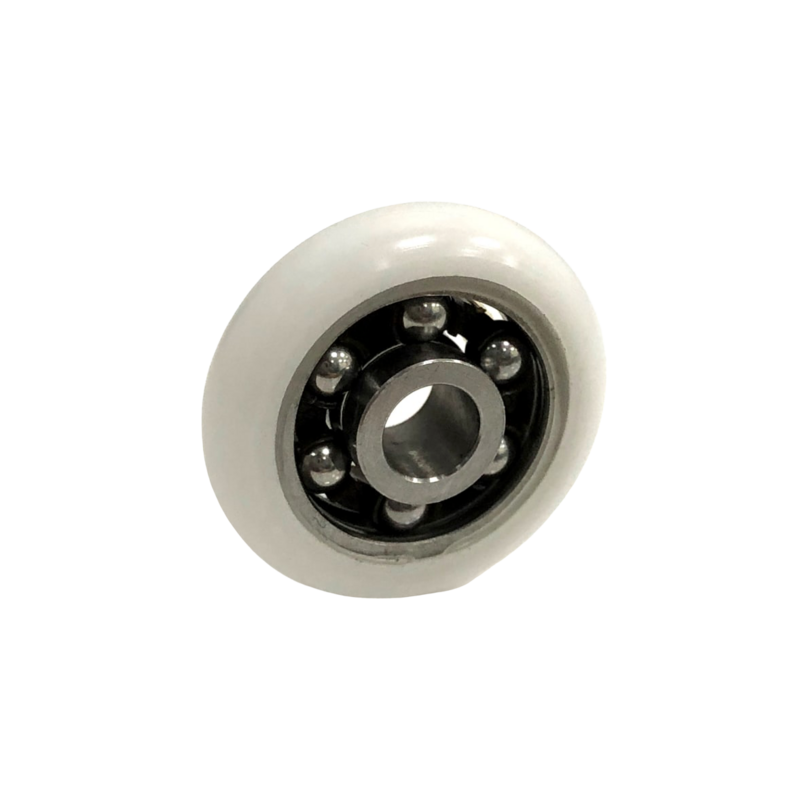
The overmolded roller is one of its critical components.
This roller must arrive as an assembly-ready finished part—not a bare bearing or a semi-finished piece.
If outer-diameter accuracy, concentricity or rolling smoothness falls short on any one axis, the sliding action and service life of the door are directly affected.
For this manufacturer, the pain point was never the bearing itself. It was the entire process of obtaining one qualified finished roller.
The customer's original sourcing process had to stitch together two to three suppliers: first purchasing bearings from a bearing maker, then commissioning an injection-overmolding shop for the secondary overmold.
If that shop could not also perform edge turning, a separate turning shop was needed to finish the part to spec before it could reach the assembly line.

On the surface this looks like a few extra machining steps.
In practice, every handoff accumulated hidden cost: cross-plant freight and repeated packaging, waiting time across separate production schedules, spec-confirmation work across multiple contact points, and the most troublesome issue of all—when a finished roller showed a dimensional deviation or a rotation problem, each shop tended to point elsewhere, leaving the buyer stuck in the middle to figure out which stage was at fault.
When ISK Bearings began its assessment, the first question was not which shop performed poorly—it was where the process had been cut apart.
Running overmolding and edge turning as separate operations amplifies tolerance stack-up between stages.
This was the core basis of ISK's judgment:
In other words, when the customer reported "runout and out-of-tolerance outer diameter," no single shop could locate the answer: the overmolding shop suspected the bearing or the turning; the turning shop suspected uneven overmold thickness.
The problem lived in the gaps between stages, where no one was controlling the accumulated tolerance as a whole.
That judgment decided the solution: not "swap in a better overmolding shop," but connect the tolerance chain across all stages under one owner.
.png)
Based on that diagnosis, ISK helped the customer integrate bearing, overmolding and edge turning into a single supply flow that delivers the finished roller directly:
 Further reading: Bearing Specifications: Common Types, Dimensions, Materials, and Application Considerations
The key difference: overmold dimension and turning allowance are no longer managed separately by two shops, but matched systematically within one flow.
The customer no longer has to manage multiple suppliers or bounce between shops to reconcile spec, lead time and quality responsibility—the assembly-ready overmolded roller arrives ready to go.
"It used to take a lot of time just to confirm each shop's lead time, and when something went wrong I didn't even know who to call. Now there's one point of contact—everything is matched before it ships to us."— Purchasing lead, architectural hardware manufacturer
Across this order of 300,000 finished overmolded rollers, after ISK integrated the process, the customer saved roughly USD 1 per unit, for a total of approximately USD 300,000.
| Metric | Result |
|---|---|
| Order quantity | 300,000 units |
| Average saving per unit | approx. USD 1 |
| Total saving | approx. USD 300,000 |
| Integrated stages | Bearing supply, overmolding, edge turning |
| Core value | Fewer supplier handoffs, less cross-plant freight, lower total supply cost |
The table above shows that at a 300,000-unit scale, this integrated-supply case delivered approximately USD 300,000 in total sourcing-cost savings, while consolidating quality responsibility—previously spread across multiple shops—into a single point of contact.
The savings came from three places: reduced cross-plant freight and repeated packaging; eliminated multi-contact coordination hours; and, once the stages were linked, a single owner controlling the accumulated tolerance—improving dimensional consistency and reducing the hidden rework cost from runout or out-of-tolerance outer diameter.
| Item | Before: Handled Separately | After: ISK Integrated Supply |
|---|---|---|
| Supplier contacts | Bearing shop + overmolding shop (plus turning shop as needed) | Single integrated point of contact |
| Quality responsibility | Hard to pin down; customer coordinates | Tracked and improved by one owner |
| Tolerance control | Each shop separate; stack-up between stages | Stages linked; controlled systematically |
| Lead-time management | Independent schedules; higher delay risk | Integrated scheduling; aligned lead time |
| Total cost | Separate quotes; high hidden cost | More competitive total supply cost |
ISK helped an Asian architectural hardware manufacturer integrate bearing supply, overmolding and precision edge turning into a single finished-roller supply flow. Across a 300,000-unit order, the customer saved roughly USD 1 per unit—about USD 300,000 total—while consolidating quality responsibility under one point of contact.
If what you need is not a single bearing but an assembly-ready overmolded roller, ISK can integrate bearing supply, overmolding and precision edge turning to simplify your supply flow and lower cross-plant coordination cost. Share your application, drawing, target spec and annual volume, and we'll help evaluate an integrated-supply solution and quotation.
Further reading: How to Install a Bearing ?
The most direct difference is clear ownership of quality. With separate shops, each handles its own scope, so when runout or an out-of-tolerance outer diameter appears, responsibility is hard to pin down. Integrated supply puts one point of contact in charge of stage-to-stage matching and finished-part quality, improving issue tracking and correction.
Outer diameter after overmolding varies because of material shrinkage. When overmolding and turning are separate, the turning datum must be re-confirmed and information between stages is easily misaligned. Once integrated, overmold dimension and turning allowance are matched systematically, giving more stable outer-diameter accuracy and concentricity.
Please provide your question. We’ll find you with the best support options.